Showing posts with label friendship. Show all posts

23 March 2022

Notes from Amy Banks' focus and lecture on Friendship

Amy Banks
WomenExplore March 17, 2022
Please note that the following is compiled from a set of rough notes. Much is omitted and some could be wrong.

Amy Banks, our speaker, gave both the Focus and the Lecture.  In the focus talk she told us about a very personal experience which is addressed in her book, Fighting Time, coauthored with Isaac Knapper. Additionally she has authored Wired to Connect, Four Ways to Click, and Mental Health for Women (Coauthor). Several of her lectures are available on YouTube.  Raised in Orono, ME, Dr. Banks is a psychiatrist in Lexington, MA, a Founding Scholar at the International Center for Growth in Connection (ICGC), and a Senior Scholar at the Wellesley Centers for Women. 

As Amy told us in the opening of her focus, her father was killed in front of the Hyatt Regency in 1979, while at a conference in New Orleans.  Isaac Knapper is a black man falsely convicted of Mr. Banks’ murder after being brutally abused during his interrogation.  After a friend falsely testified against him, Isaac served thirteen years in Angola, the Louisiana State Prison. He was declared wrongly convicted, and released in 1992.  He received no monetary compensation when Laurie White (now a judge) sued New Orleans on his behalf.  Having no way to support himself or his four children, Isaac became a drug dealer, was unjustly labeled as a "king pin," and imprisoned in a federal prison until 2015. He confessed his guilt to this crime and admitted it was a bad decision on his part. The Banks family did not find out that Isaac had been exonerated of their father's murder and released until 2004 when Amy's sister Nancy's husband googled Isaac.  Nancy had been 8 years old when her father was murdered. 

Amy blames Harry Connick Sr, the New Orleans DA from 1973 to 2003.  He does not accept that he ever did anything that was wrong.  In fact the Supreme Court had previously found that defendants had a right to be given any exculpatory evidence obtained by the police or prosecutors.  In Isaac's case three other young men had been picked up nearby at a similar time. One of these was carrying the gun that had killed Ronald Banks.   

The horrors of Hurricane Katrina in 2015 stirred up a lot of emotions in Amy and her sister Nancy.  Amy reached out to Laurie White and remarkably got a response with 24 hours.   Amy then came up with the idea of meeting Isaac in person. Amy and Isaac have become friends and colleagues, writing the book and giving talks about the justice system and building friendships across differences.  They will soon give a joint seminar / training session to the New Orleans police department.


There are 50 Innocence Projects in America. They recommend videotaping interrogations of suspects. The conservative estimate of wrongly convicted inmates in America is 6-10%. Amy will forward a handout on the Innocence Project and blog post.  There is an Innocence Project of New England where you can check for more information and for ways to help.


The Neuroscience of Connection 

Healthy relationships are central to everything

The Stone Center at Wellesley was formed in the late 70s to discuss cases.  Relational Cultural Theory was developed there. It has evolved into the International Center for Growth in Connection (ICGC).

It is a human tendency to look at people and stratify them into what makes them different from us. We need to balance our cognitive and emotional responses, reign in judgments, and learn how to bridge differences.   With Amy and Isaac, she had to hear his pain and share her pain, to stretch and shape herself, and be heart-centered.

The individuation and separation model was replaced with growing toward relationship. The centrality of relationship is harder to hear; without relationship we become sicker and die earlier. The separate self concept is toxic as Amy wrote in Wired to Connect. 

Stephen W. Porges wrote "The Polyvagal Theory” which is the newest branch of research on the autonomic nervous system (ANS).  He identifies the "smart vagus" as a third branch of the ANS, the other two being the sympathetic and parasympathetic.

Neuroception:

Safe: Smart Vagus Nerve

Dangerous: Sympathetic Nervous System

Life Threatening: (PNS) Parasympathetic Nervous System.

     Causes us to freeze when threatened so we don't feel pain.

Dr. Banks created a user friendly way to assess relationships named “The CARE Program.” 

C is for Calm relating to the capacity of the smart Vagus.

A is for Acceptedness (Social Pain Overlap Theory)

When socially excluded, we feel pain in the dorsal anterior cingulate gyrus, the same part of our brain that reacts to physical pain.  We feel sick. 

In a “power-over culture,” people are pitted against each other in competition for social capital.  A judging brain causes pain.

is for Resonance  - Mirror neurons mimic others' emotions and actions in our own minds.  Interactions with similar people (as we each define similar) allow the mirror neurons to operate.  With dissimilar people we need to fall back on abstract thinking in our dorsal medial pre-frontal cortex instead. We use a disconnected way of knowing. We need more skills in bridging differences.

is for Energy derived from the dopamine system.  Healthy relationships give rise to dopamine, which provides us with energy and motivation.

Some alternative ways we stimulate the Dopamine Reward System when our relationships are not nurturing us include:

Drug Abuse  (The US leads the world in drug abuse.)
Sex Addiction
Overeating
Extreme Novelty 
Materialism
Risk Taking 

That these exist implies an over emphasis in our society on power systems.  Power redefined would be the capacity to produce change – to facilitate movement, to move and be moved by another.

Handouts:

23 May 2019

Regina

One ribbon in the Story Quilt of:
How Do I Share My Money, Time and Love? — A Woman's Dilemma
—By Barbara V.


     Regina and I met in 1980 when we both worked at Shawmut Bank.  We found ourselves in the same master’s program at Simmons College.  We shared a love for exploring new ideas, we both enjoyed working, and we both loved Boston. She told me about her family, and I told her about mine.  She was my biggest supporter, a conscientious listener, a real girlfriend who enjoyed a shopping trip to Chestnut Hill.  She instilled in me a confidence that I would not have had without her.  We didn’t always see everything the same way, but we never argued.  She would explain her position and would listen while I explained mine.  Rarely did either of us win the other over, but we always had a healthy exchange of ideas.  Regina introduced me to Tanglewood, the Christmas Pops, the Peterborough Players, and dinner at The Ritz.  
    When I began teaching public speaking at UNH, Regina thought she would like to do the same, so I took Regina’s resume to the department chair, and soon, we were both working as adjunct faculty.  
     Every evening before class, we would meet at a little restaurant in downtown Durham for dinner.  The first class was always a bit chaotic, and Regina had a lot of students at her door who were not registered.  Each had a compelling story as to why they needed the class.  Regina admitted all of them.  How she handled a public speaking class that was double the usual size, I’m not sure, but she figured it out in true Regina fashion.  The students loved her! 
  When I moved to Hesser College in Manchester, Regina called and asked if there was a job for her.  I took her resume to the dean, and Regina was hired as an adjunct instructor teaching a variety of business courses.  A few years later, she was brought in as a full-time consultant. 
     Every morning around 10, Regina would come in with her cup of coffee, and we’d sit and catch up. There were other instructors and staff who she also checked in with during the day.  Regina loved to focus on a project.  She could churn out more work than anyone I knew, but she also enjoyed the relationships she developed in the workplace.  She cared about people.  She cared about what was going on in their lives. She believed in education, both for herself and others.  
     Regina was a wonderful story teller, and I’ve never known anyone who knew so much trivia.  She was a voracious reader, and that could include serious books, fiction, and pop culture magazines.  She watched a lot of television, surviving on very little sleep.  She was always reading more than one book at a time.
     Mornings were a magical time for her.  She always said that when she heard the birds chirping, she knew it was ok to get out of bed. 
     One night on the way home from work, Regina stopped at the animal shelter and asked to see the cat that nobody was interested in adopting.  They brought out an older cat which Regina said she would take. Then they brought out two other cats that no one was interested in.  Regina adopted all three of them.  And then there was Pyewacket: the kitty that turned up on Regina’s doorstep during a raging blizzard.  Regina opened the door, and the rest, as they say, is history.  
After her mom died, Regina began hiking up and down the mountain near her home by herself.  I was concerned that she was hiking alone, but those hikes helped Regina deal with her grief.  I was always impressed with how Regina would simply rise to the occasion and deal with whatever the issue was.  She did that at work, and she did that at home, often relying on her faith, which was an important part of her life
     Regina’s solution to everything has always been hard work and acquiring more education.  She enrolled in a Master’s program at Boston College in Administrative Studies.  She was commuting to BC from Hancock and living in the college library when she wasn’t in class.  I’d rarely hear from her because she was putting her usual 150% effort into her studies.  Once she completed her degree, she said she was going to look at employment opportunities in the D.C. area, and went to visit Ginny in Virginia.  
     Regina told me stories about her family. I knew Ginny and Dave had a passion for the hunt. I knew about Arthur and his family’s move from the cold north to sunny Scottsdale. I knew that Peter could answer all my gardening questions.  Regina kept me up to date on the lives of her nieces and nephews, their weddings and their children.
         The family house and barn in Hancock where Regina had grown up was her refuge.  She loved working the property in the summer and shoveling snow in the winter.  When a stranger asked to take a picture of the barn and the picture appeared in a calendar of barns, Regina was as proud as could be.  She gave me one of the calendars for Christmas. 
      I worried about Regina in the winter when she would lose power and the sump pumps would stop working, and the basement flooded. When the power went out, the house would have no heat. One winter storm left her without heat for two weeks.  I begged Regina to come stay at our house, but she wouldn’t budge.  I can’t imagine how she survived living in that cold, but she did, more than once.  When Regina needed professional help maintaining the property or her car, the professionals she called were all friends whose families she knew. I think she had them all on speed dial. 
     As often as she talked about selling her home in Hancock, I knew that in her heart of hearts, she never wanted to leave the place she grew up.  As willing as Regina was to take on new jobs and new educational challenges, that same sense of adventure wasn’t in play when it came to making changes that involved her personal life.  Those decisions were much more difficult for her.  
     When we would discuss the future, Regina was absolutely convinced that she wanted to keep working.  Working provided a routine and a focus.  I think it also provided social interaction which was important to her.  In typical Regina style, she enrolled in a weekend Doctor of Education Program at Regis to prepare herself for the next step in her career.  I don’t think Regina understood how she could possibly fill her time without a job to go to every day
 Regina almost always spent Thanksgiving, Christmas, New Year’s Day and Easter having dinner with my husband, Larry, and myself, but last year, even though we tried, we were only able to get together for Easter.  I always made an Easter basket for Regina filled with lots of chocolate which I optimistically hoped would carry her through the year.
     Over the decades, Regina and I spent a lot of time together.  Not enough, but a lot.  One New Year’s Day, we headed into Boston for lunch.  The day was unusually warm.  I found a parking place on the street in Boston.  We walked through Copley Square looking at the melting ice sculptures from First Night.  We ate in Copley Plaza’s Oak Room, and we talked and talked and talked.  Before we left the city, we drove around the Common to see the Christmas lights.  We had a perfectly charmed day.  
     When I remember Regina, I want to remember that day with a wonderful friend who enjoyed life, who loved her family and friends, whose religion was her strength.  A woman who dedicated herself to being a good person who could make a difference in the world.  A person who touched people’s lives.  

Regina, you defined for me what friendship is, and I will be forever grateful for the time we shared together.

12 May 2010

Watch Like a Hawk


By Cheryl Suchors
Right now hawks are raising their young.
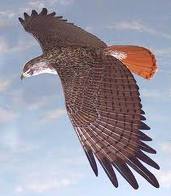
I’ve been aware of hawks, especially red-tailed hawks, since my tenth wedding anniversary when we celebrated with a trip to Sedona, Arizona. We signed up for a day trip to a “vortex” where the meridians of the earth come together and one feels a special energy conducive to meditation and the like. This is the sort of thing, besides hiking in gorgeous red rock country, that one does in Sedona, and I didn’t want to miss it. On the way to the place, the guide leaned out of the Jeep window and pointed out to us a hawk circling above us. “Red-tail,” he said. “See the flash of red?”
red-tailed hawk flying so you can see tail
I didn’t see a flash of red no matter how hard I tried, but I’ve been alert to red-tailed hawks ever since. At my daughter’s grade school, a group from a bird sanctuary came to give a special presentation, bringing in birds of prey of all kinds. There I learned that red-tailed hawks are often called “highway hawks” because of their propensity to circle above highways looking for road kill.
So they’re smart, I figure. Perhaps a bit lazy? Or maybe that’s just easy for an animal who finds food at a grocery store to say.
What is true is that you will find red-tails in desert, grasslands, cities and parks, even, says the Cornell Lab of Ornithology, in the rainforests of Mexico. Being able to adapt to such varied terrain sounds pretty smart to me.
The Meaning of Hawk
In Native American and Wiccan traditions, Hawk is known as a messenger from Spirit. The message Hawk brings to those whom she visits is: be aware. “Watch,” she tells us. Perceive with that wonderful vision that lets Hawk see both the big picture and the minutest mouse in the grass. There is a signal intended for the person who sees hawk, a signal only s/he can intuit. Unraveling the message, as is true for all portents, tends to be an idiosyncratic task.


The general message of Hawk is live your life with a keen eye and be ready to dive upon an opportunity in an instant. I also understand it to suggest soaring—to get a different, wider perspective on events in one’s life. And maybe this is just my own interpretation, but Hawk instructs me in the twin arts of joy and rest. What could be more jubilant than flying? What could be more clever than using air currents to keep one airborne, gliding and resting while waiting for the moment of action to come?
For me, red-tailed hawks also symbolize friendship and partnering. I often, at least when they’re hunting, see a pair of hawks circling. Four eyes are better than two, apparently. The father of a brood also helps build the nest, find food and even sit on the eggs or the nestlings when necessary. Mated pairs typically stay together until death does them part.
Red-tailed hawks are also remarkably lightweight. Despite a wingspan of between three-and-a-half feet and nearly five feet, even the biggest females rarely weigh more than three pounds. Perhaps there’s a message here, too. If we want to fly, to soar, to move with the wind, we need to lighten up. Perhaps we are meant to reduce the burden of what we carry with us, be it physical, mental or emotional.
Watch a Red-Tailed Family Grow
One of the things I like best about these amazing birds is that they frequent the city. In Cambridge, Massachusetts, I’ve seen them perched high up in a tree in my neighbor’s yard or at Fresh Pond Reservoir. Or on top of a flagpole or the roof of a tall building.
Right now you can watch, close up and personal, an amazing daily miracle: two red-tailed parents raising a brood. Their nest is in a building (185 Alewife Brook Parkway) opposite a shopping center. You can see pictures of them from eggs to nestlings to fledglings, at Cambridge Community Television. Ernie Sarro who produces “The Expert Series” for CCTV, has a contest going to name the baby birds. He’s already christened the parents Ruby and Buzz. Check out his amazing videos of the red-tailed family! 


  —Cheryl Suchors