Showing posts with label Cheryl Suchors. Show all posts

13 August 2010

WWII B-18 Bomber Crash Site Hike

—Cheryl Suchors


This was a hike with history. On January 14, 1942 at 7:40 in the cold, dark night, a US B-18 Bomber crashed into the shoulder of Mt. Waternomee in North Lincoln, NH. The shock made tableware dance and windows rattle; even in Plymouth, 22 miles away, people wondered what on earth had happened.

Only weeks after the bombing of Pearl Harbor, the citizens of North Lincoln and nearby Woodstock initially thought they were being attacked by the Japanese. The first rescue crew to reach the crash site wasn’t sure whether they were aiding enemies or allies.

I won’t give away more of the story, but I will tell you that the heroism of the soldiers who survived the crash—and astoundingly five out of seven did—and the heroism of the townsfolk who worked so hard during a bitter blizzard to keep them alive, moved me deeply.

Mt waternomee B-18 bomber crash site hike plaque in their honor

While the rest of our group settled down for lunch, I spent some time alone at the memorial site, thinking about these utterly amazing, utterly ordinary people, and lit a candle in their honor.
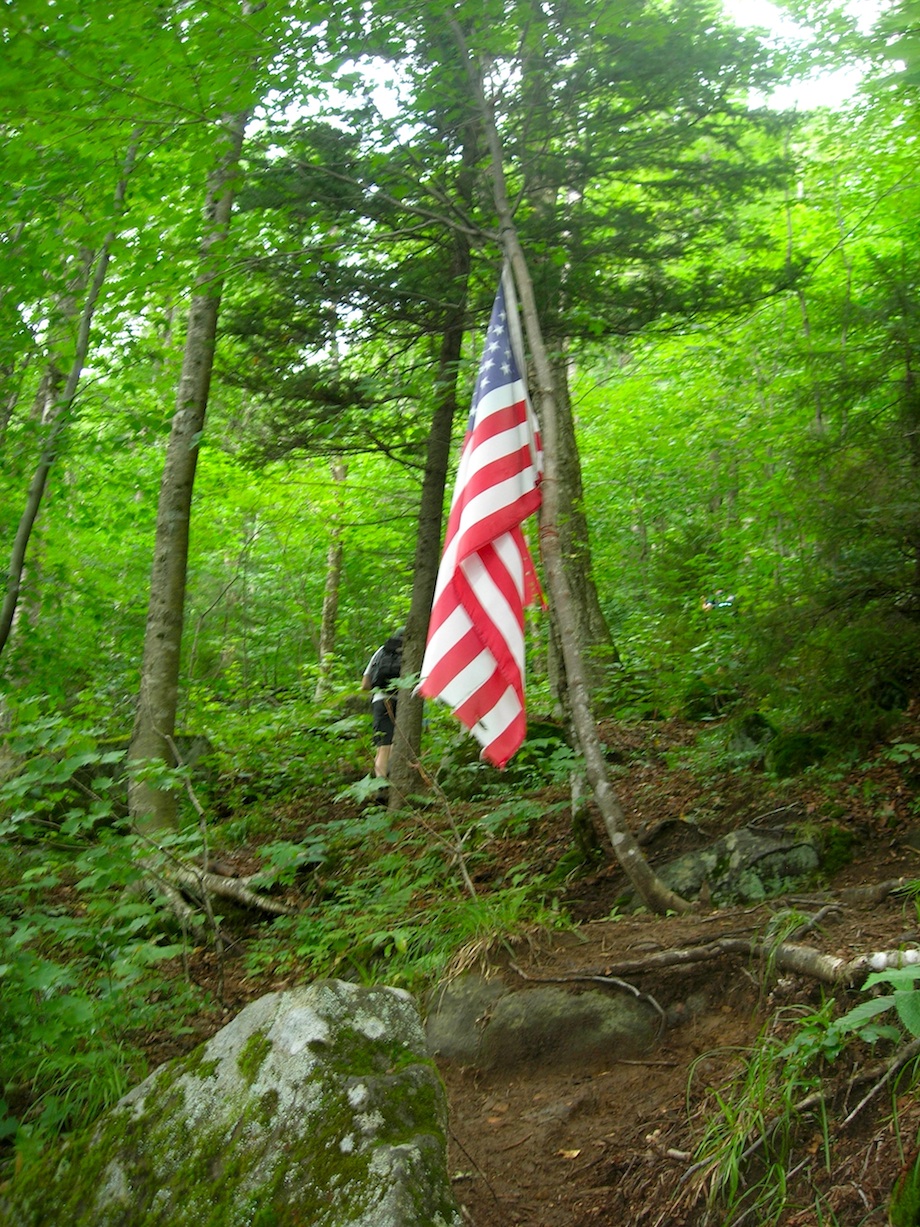
flag in the forest mt Waternomee B-18 bomber crash site NH

Everything I know about these people comes from a booklet written by Floyd W. Ramsey, The Night the Bomber Crashed. If you can, read it before you do the hike; it will make a difference, I assure you.

From Meadow to Woods

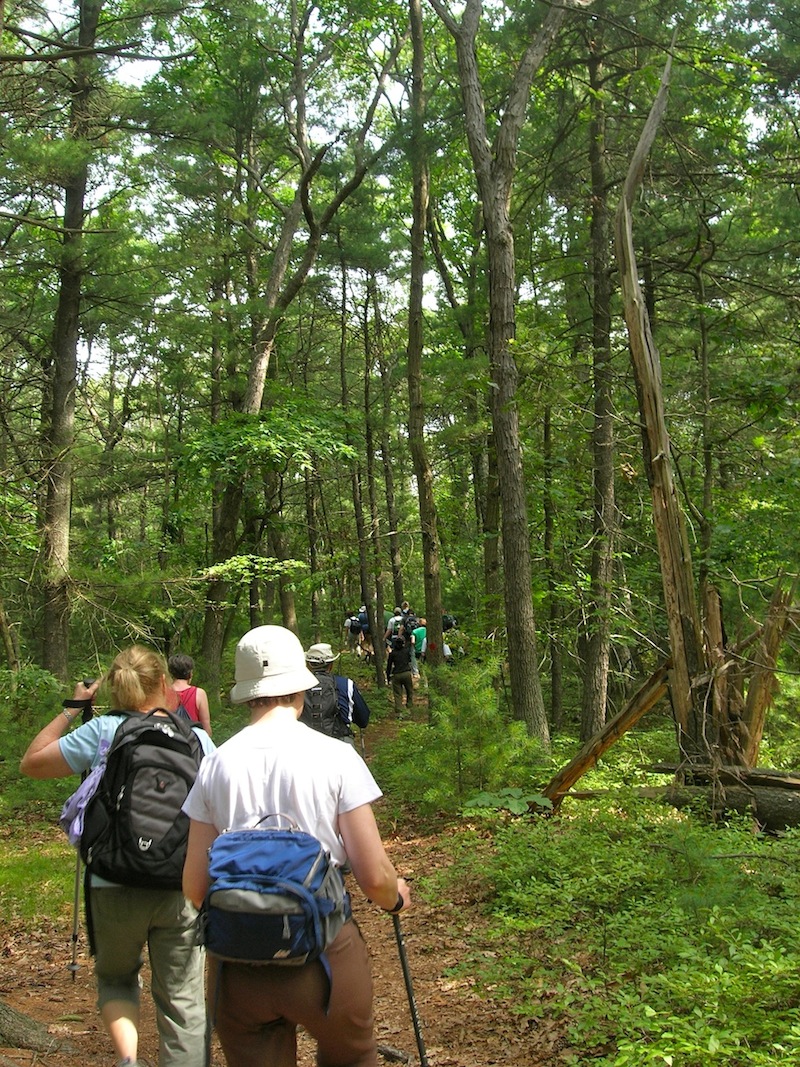
Despite a forecast of rain, we started off our 4.6 miles in sunshine and fine fettle, marching along an old logging road overgrown with grass and wildflowers.
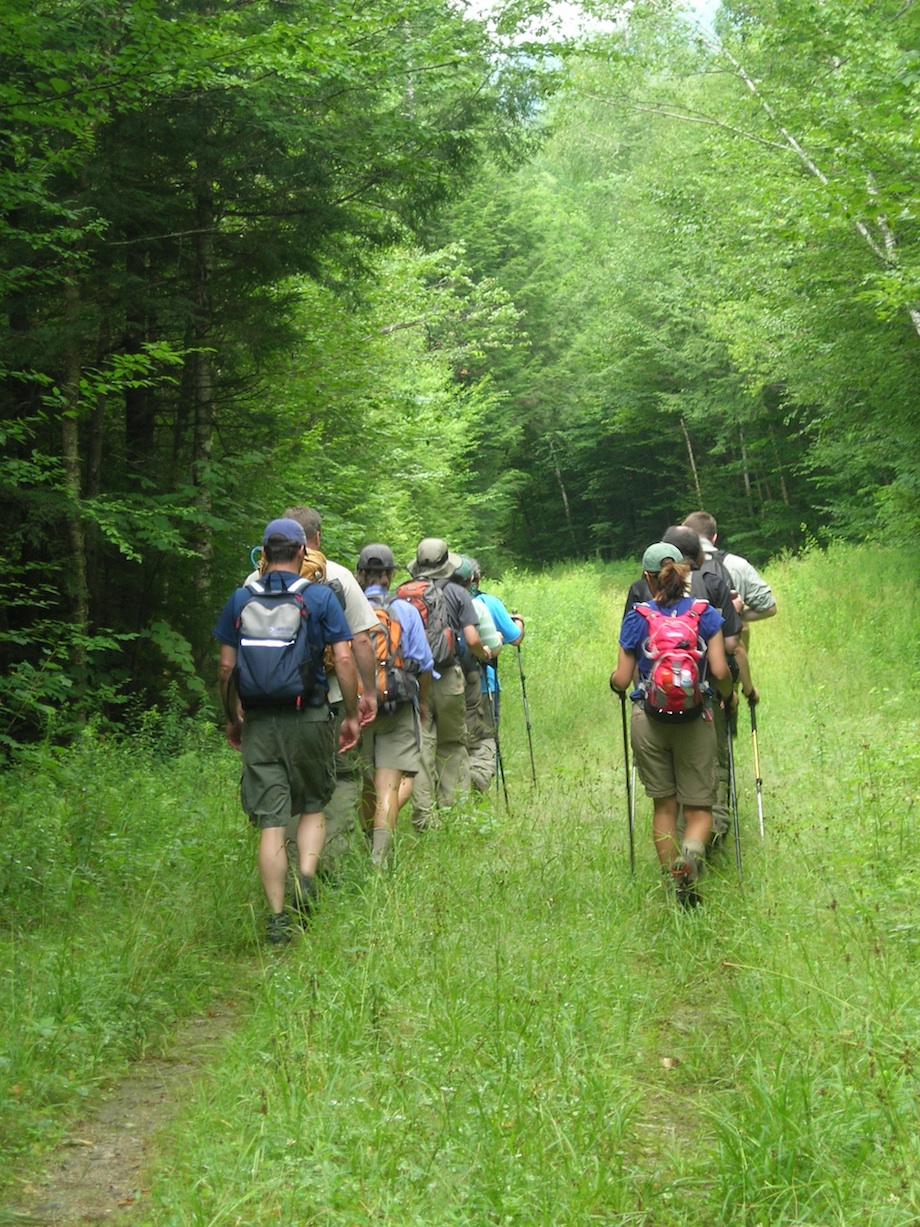
Hiking in two rows B-18 Bomber Hike AMC July 24, 2010

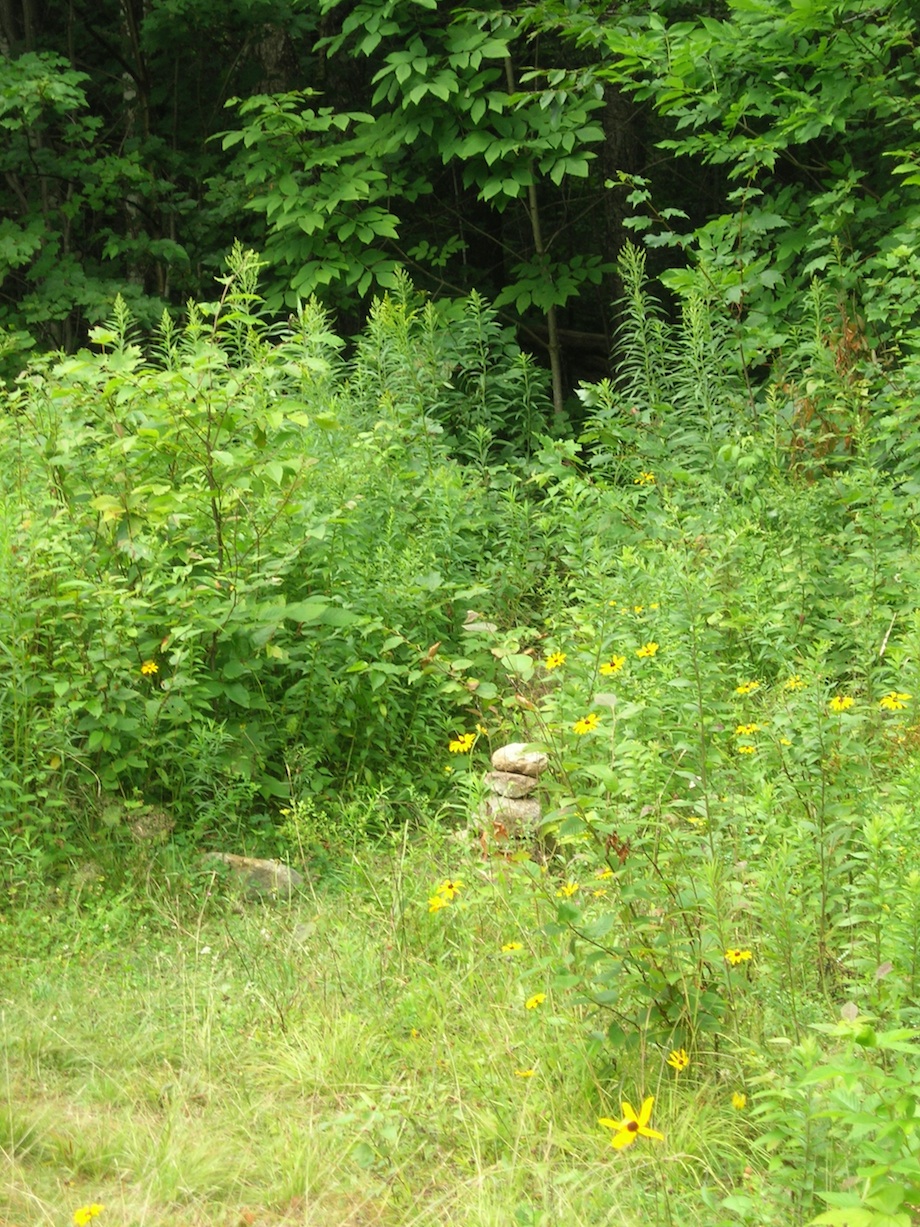
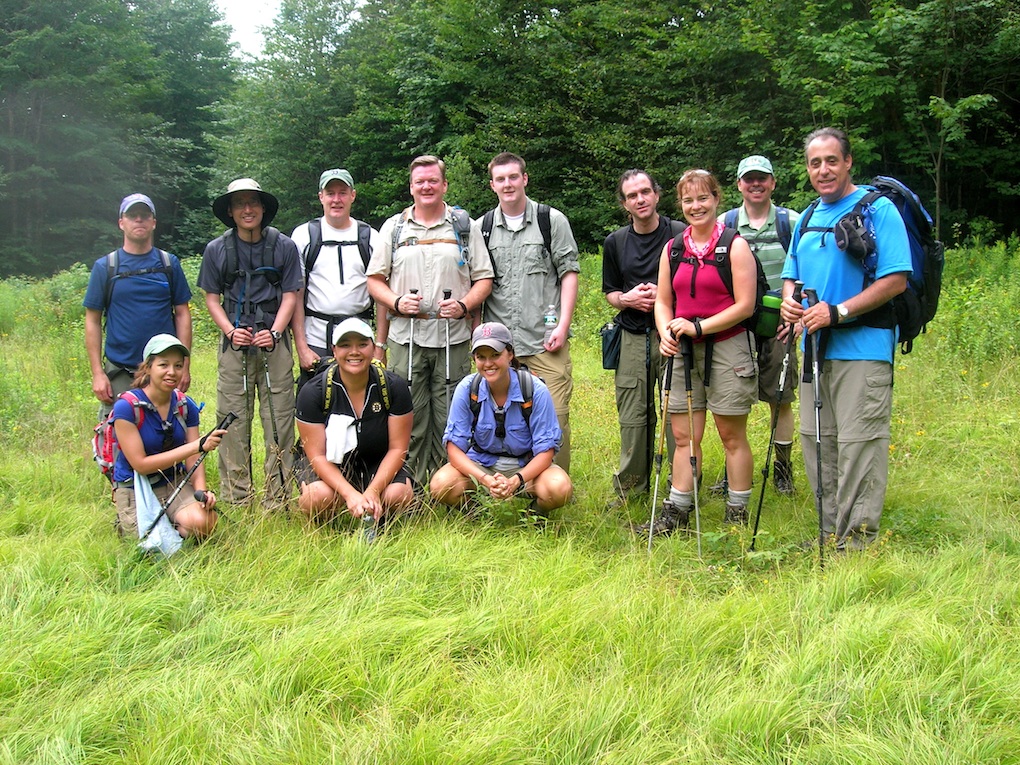
In about half a mile, we came to a surprisingly perfect circle of meadow that signaled our turn onto the trail, and a perfect spot for a group picture. 13 hikers in big meadow circle B-18 Bomber Hike July 24, 2010The trail was marked by a tiny cairn, nearly hidden in the grass, that someone had recently built to mark the way.B-18 bomber Hike AMC July 24, 2010 cairn marking trail into woods
Entering the forest, the landscape changed dramatically. We charged along, sweating in the heat and humidity, grateful for the dense shade. Drinking, a lot of drinking, became de rigueur.
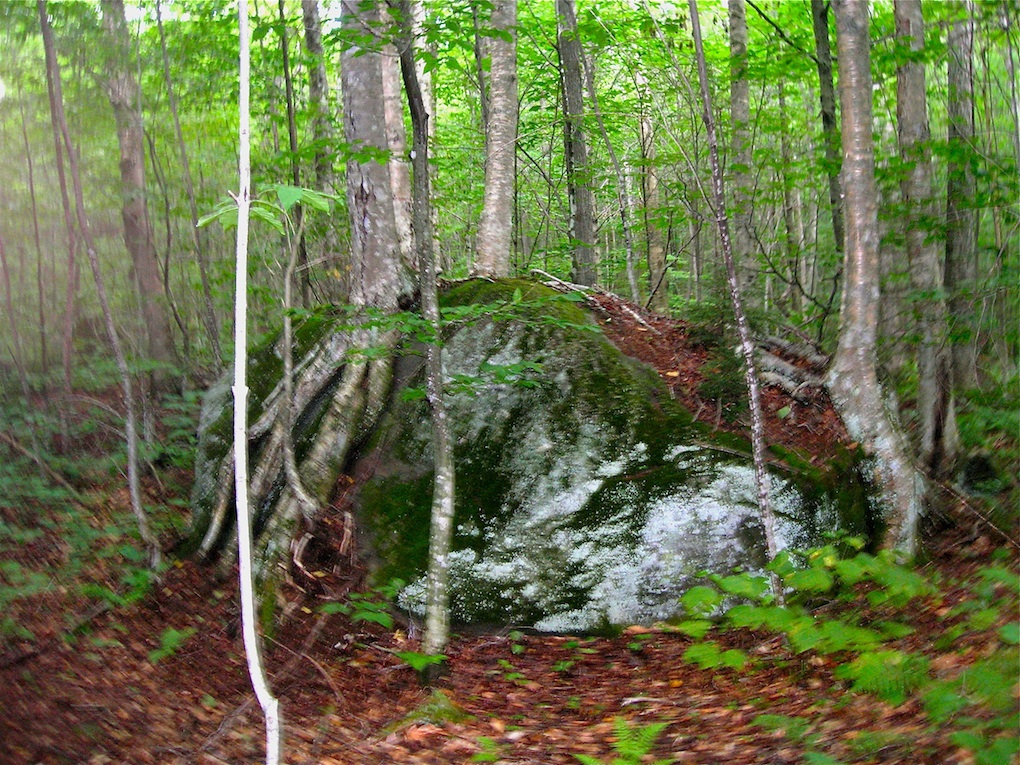
B-18 bomber Hike AMC July 24, 2010 trees growing over rock on trail into woods

The trail steepened considerably, with much of the 1350’ elevation gain coming in the last mile. Sweat soaked our clothes.
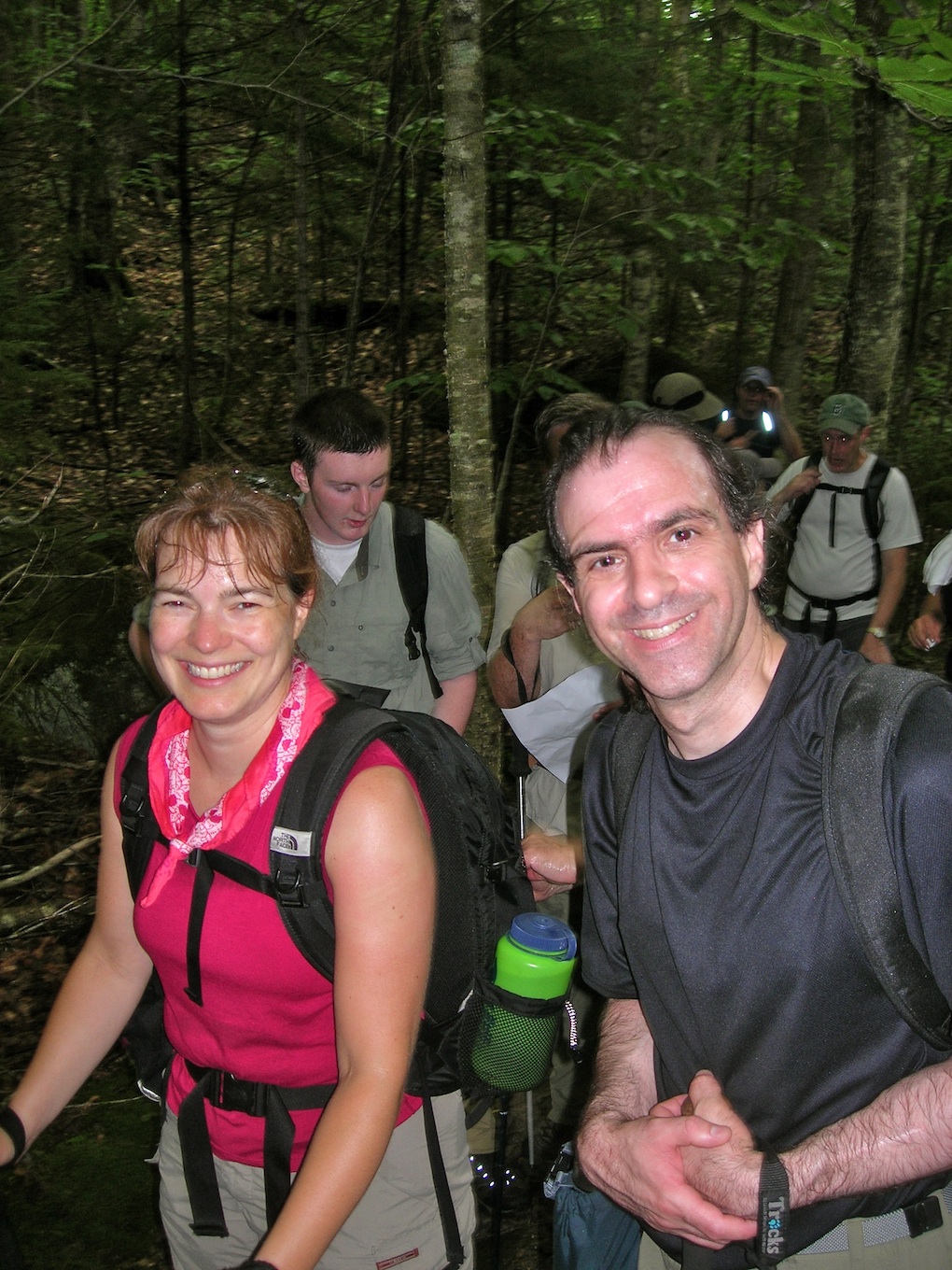
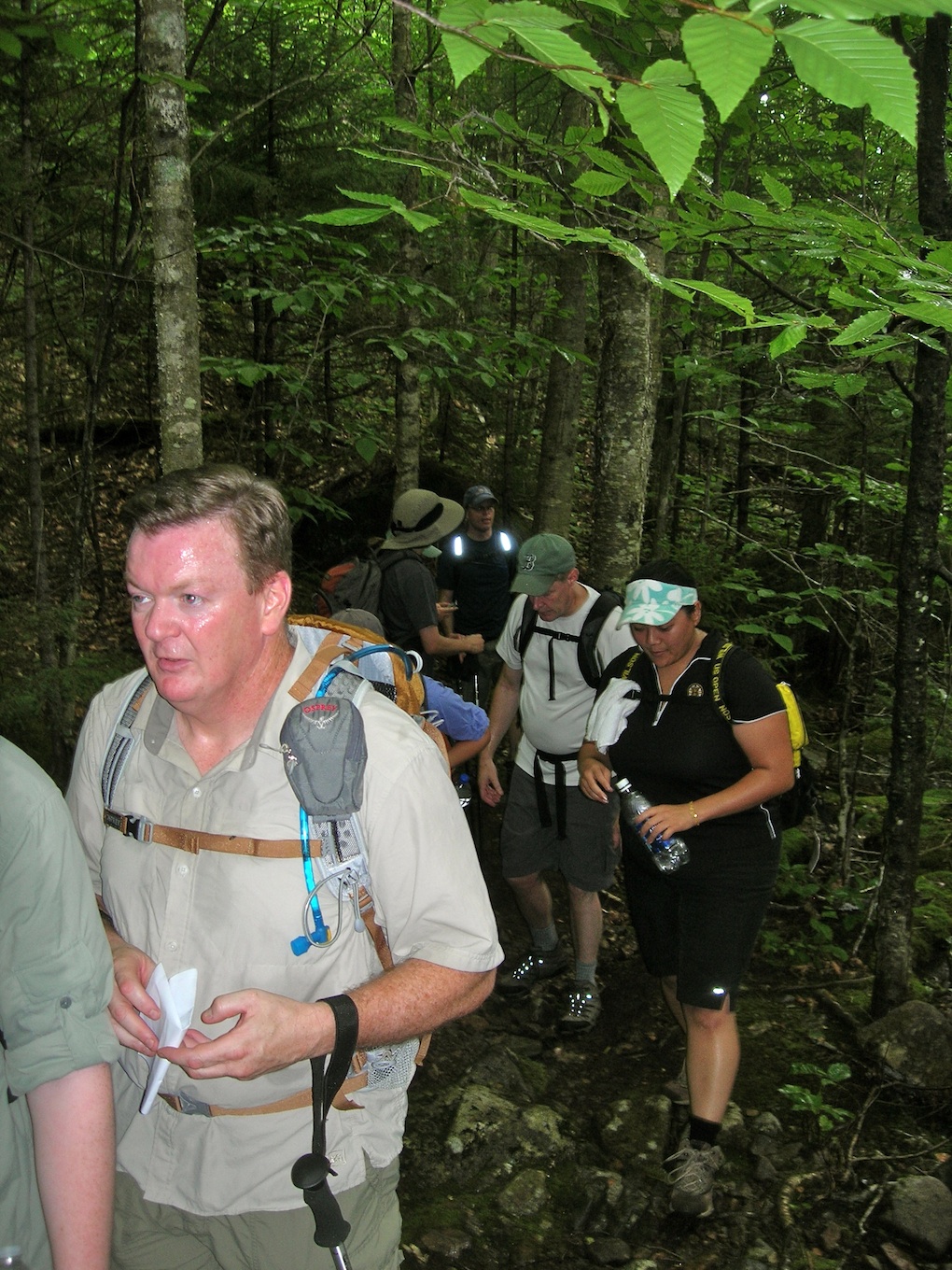
At least the footing was nice and soft, almost mushy on this un-maintained and rather unknown trail compared to the usual rocky tramp in the White Mountains. On the other hand, it was slippery. Going up wasn’t so bad, but later on, when we descended, people slipped and slid and the occasional ankle was turned, though none seriously.

The Crash Site

I was merrily chatting away to folks from the “sweep” position, when I noticed that the line of hikers ahead of me had not only stopped but dispersed. What was up? It took me a moment to realize the lump of something to my left was not another rock, but an airplane engine.
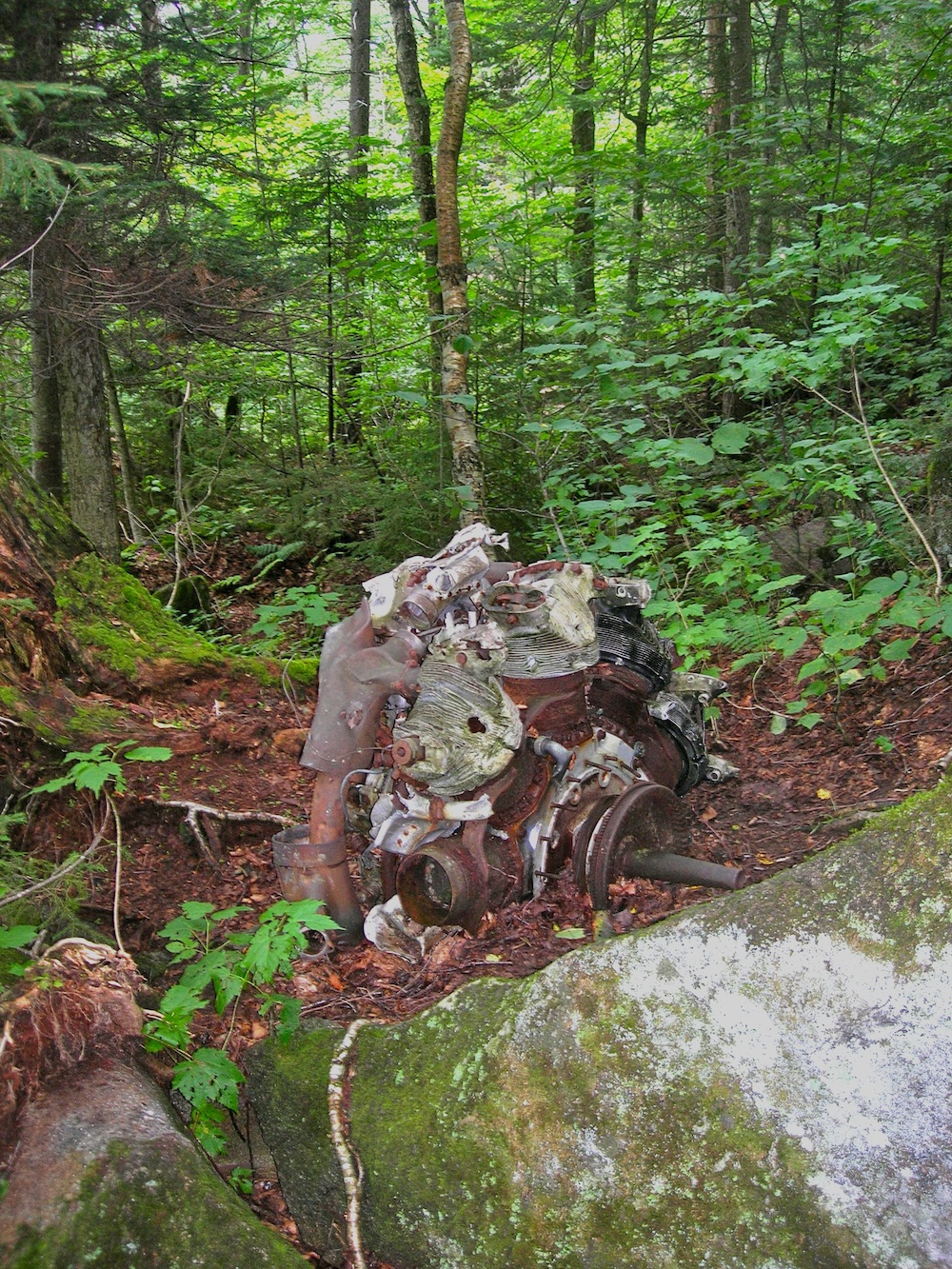
B-18 bomber Hike AMC July 24, 2010 engine in woods

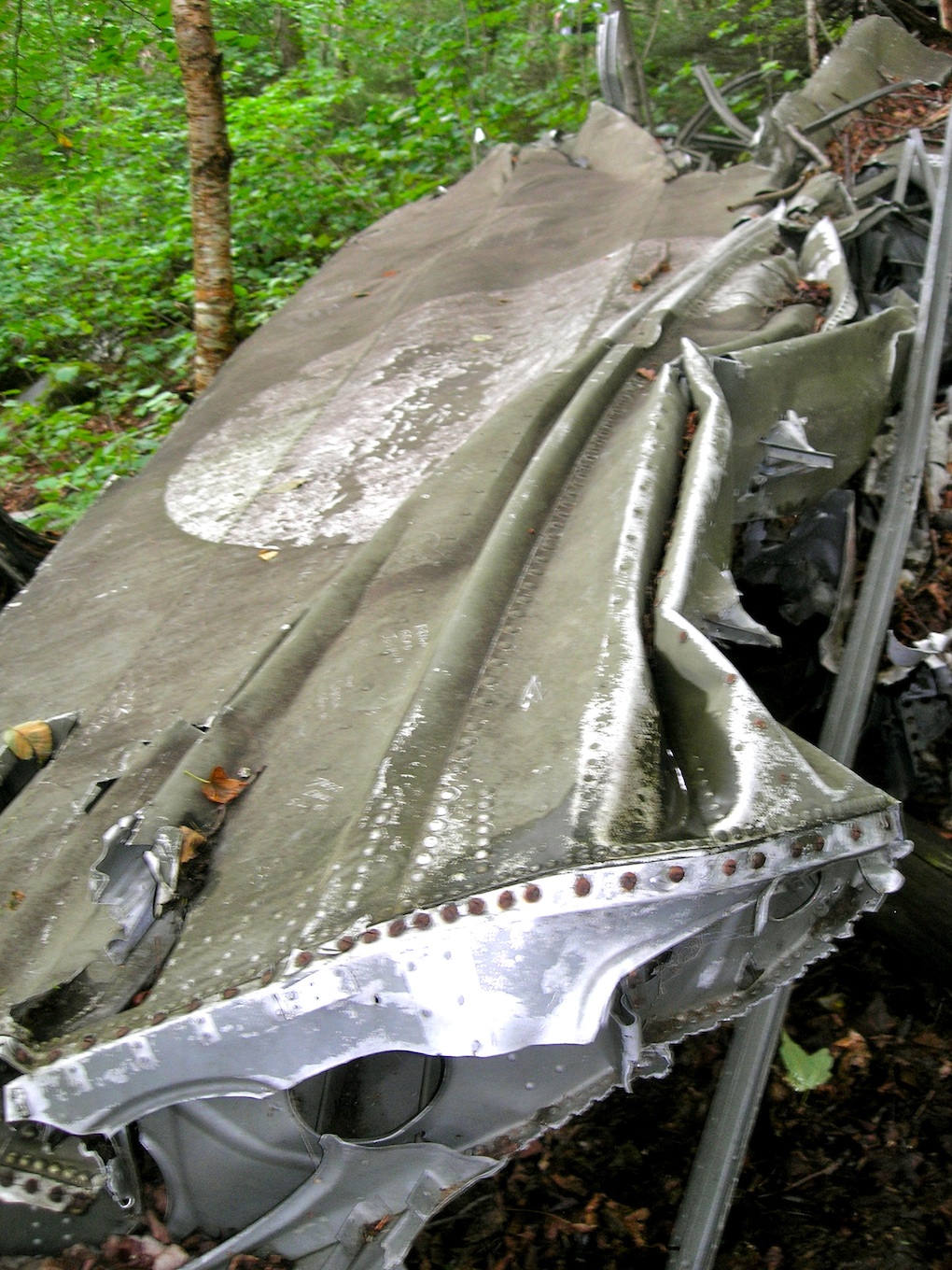
The B-18 crashed high and then skidded at an angle through the trees going downhill, tearing off its wings, splitting open the fusilage, and losing its landing gear in the process. But that’s not how you come upon the wreckage. You climb up to the last bits to fall off or explode away.

First you see an engine, then other chunks and hunks or metal and gradually you piece together a doorway, a hydraulic part, and then, at the highest part of the mountain, the wings. Looking down from there you can see the line the bomber made tearing through the forest to its final rest and the explosion of the plane itself and one of the 300 pound bombs it carried.
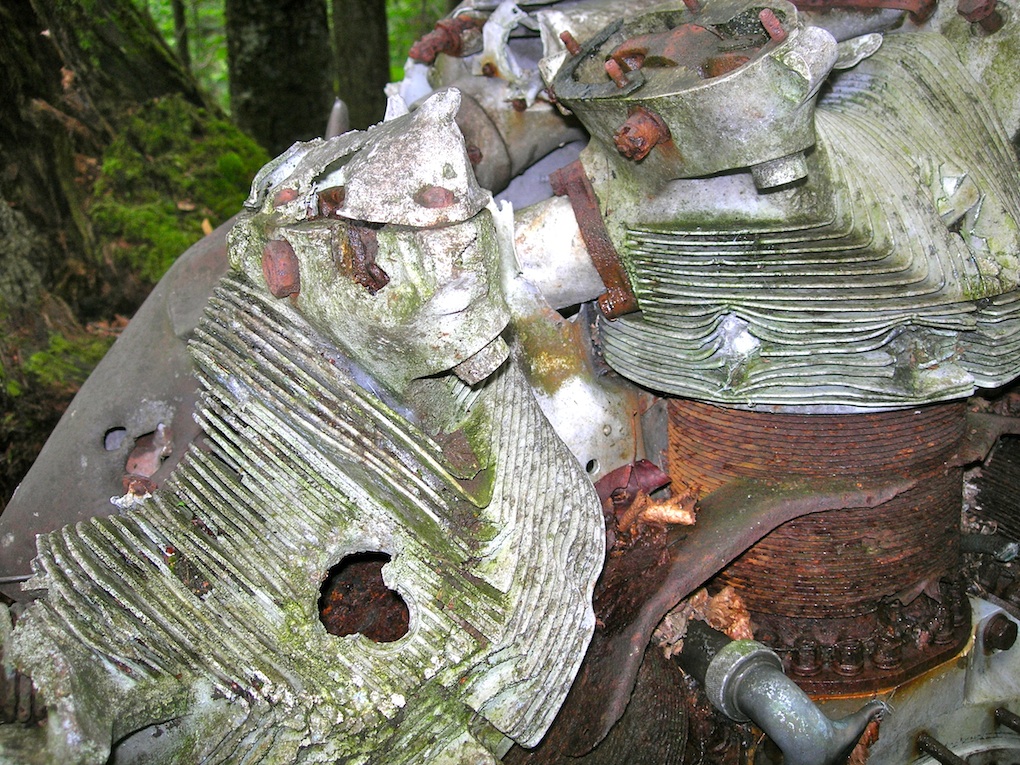
B-18 bomber Hike AMC July 24, 2010 engine in woods closeup

The remaining bomb lay there, near the burning wreckage, the entire time of the rescue. It was eventually detonated by military personnel the next day.B-18 bomber Hike AMC July 24, 2010 wing

Some of the wreckage takes fantastical shapes. Some of it looks like litter.

Parts of the plane flew far and wide from the various blasts, so the field of discovery is broad here in little traveled Mt. Waternomee.

B-18 bomber Hike AMC July 24, 2010 airplane litter

Though the burn marks and scars on the mountainside have healed completely, it’s astonishing how fresh the metal parts still look despite the nearly seventy years the forest has had to work on them.
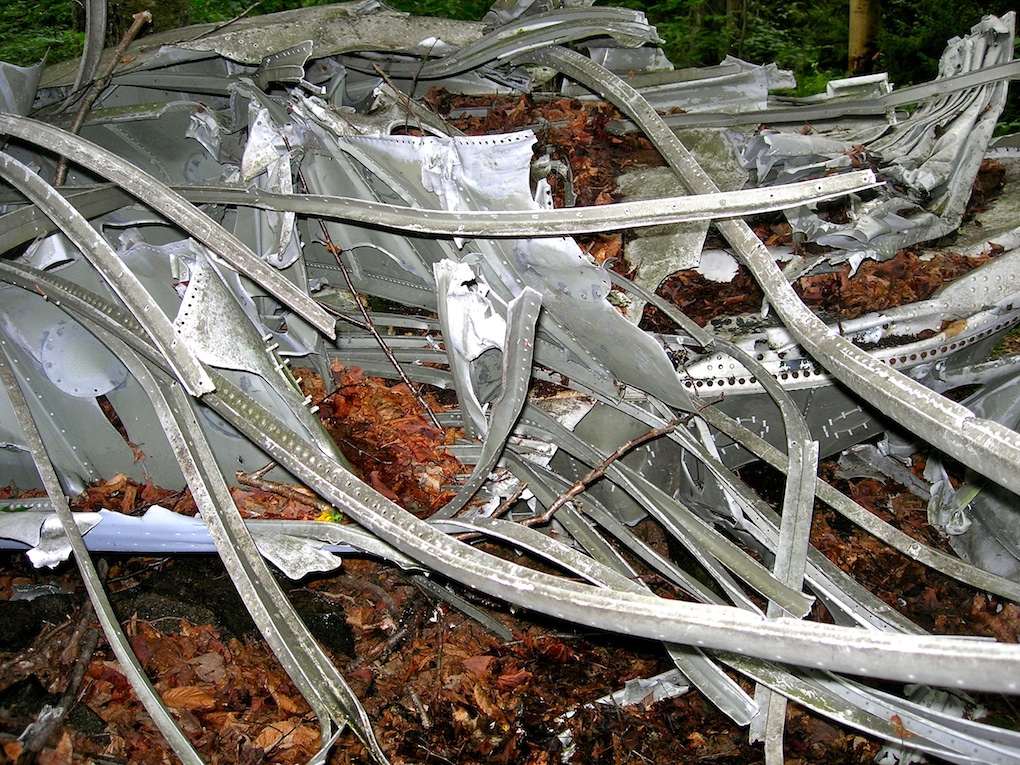
fantastical shapes B-18 bomber crash stie July 24, 2010

We Find the Falls

We ate lunch on the flattest spot we could find, surrounded by chunks of wreckage. It felt like sitting in some ancient ruins.
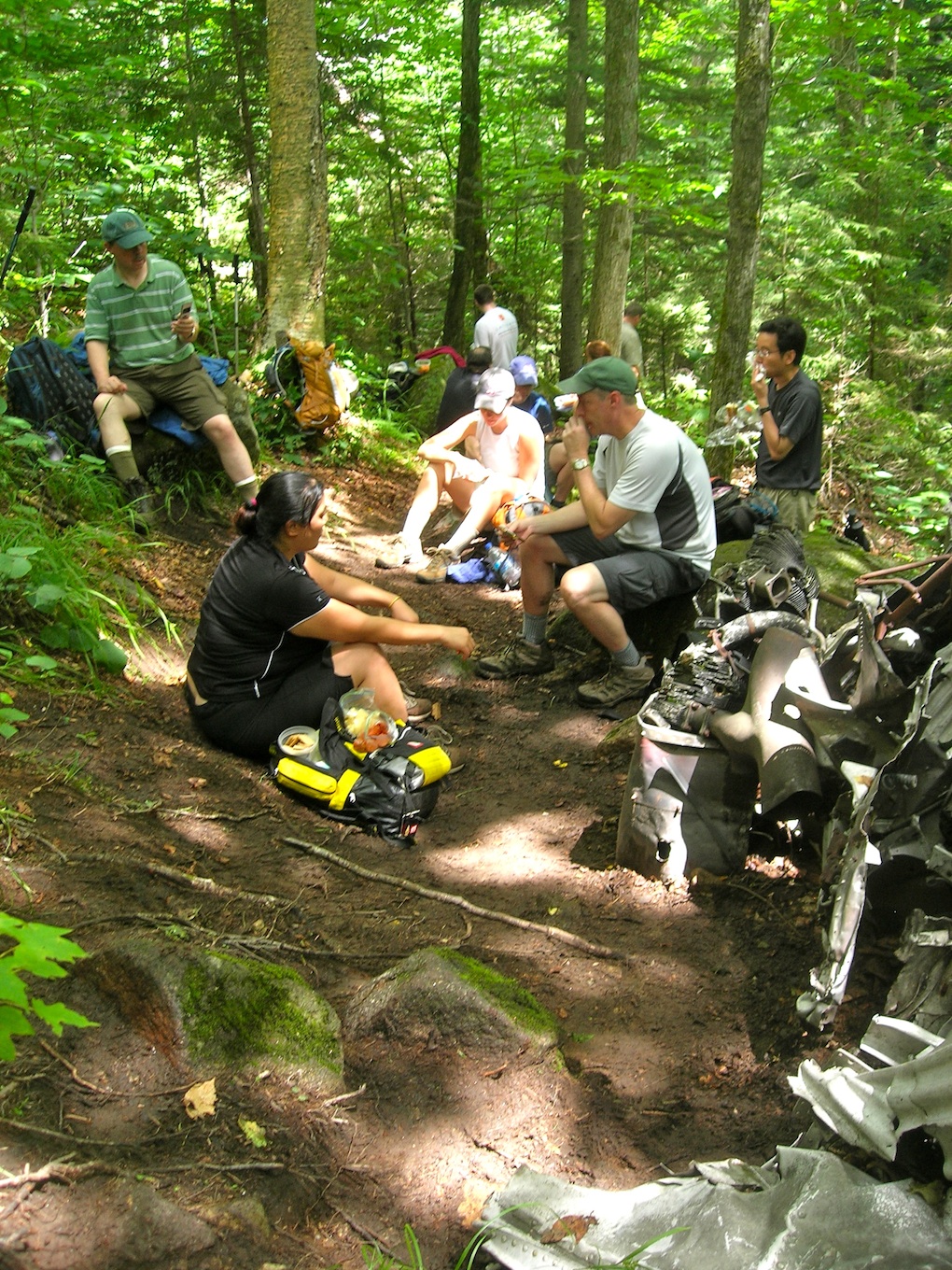
Lunch  B-18 bomber crash stie July 24, 2010

Lunch  second pic  B-18 bomber crash stie July 24, 2010

On our way down Mt. Waternomee, Robert was able to locate the falls he’d seen when he scoped out this hike a few months before. There’s no trail per se, one has to simply wait until the sound of water comes at you from both sides, the climb up the embankment on the left as you face downhill and voila! A beautiful, rugged stretch of rocks and falling water.

Some of us hiked down the steep embankment to the water’s edge while others rested on the trail above. Three adventurers, Andrew, Randy and Frank climbed up the mossy rocks to wet themselves with the cold water and enjoy the refreshing breezes. Not me. I was content to meander along the water’s edge and take pictures.

Randy at waterfalls  B-18 bomber crash stie July 24, 2010

As we came near to the end of our journey through the forest, I noticed an arrangement of Nature that looked like wooden brushstrokes representing a Japanese or Chinese character. What did it symbolize? The word “peace” came to my mind.

What does it say to you?
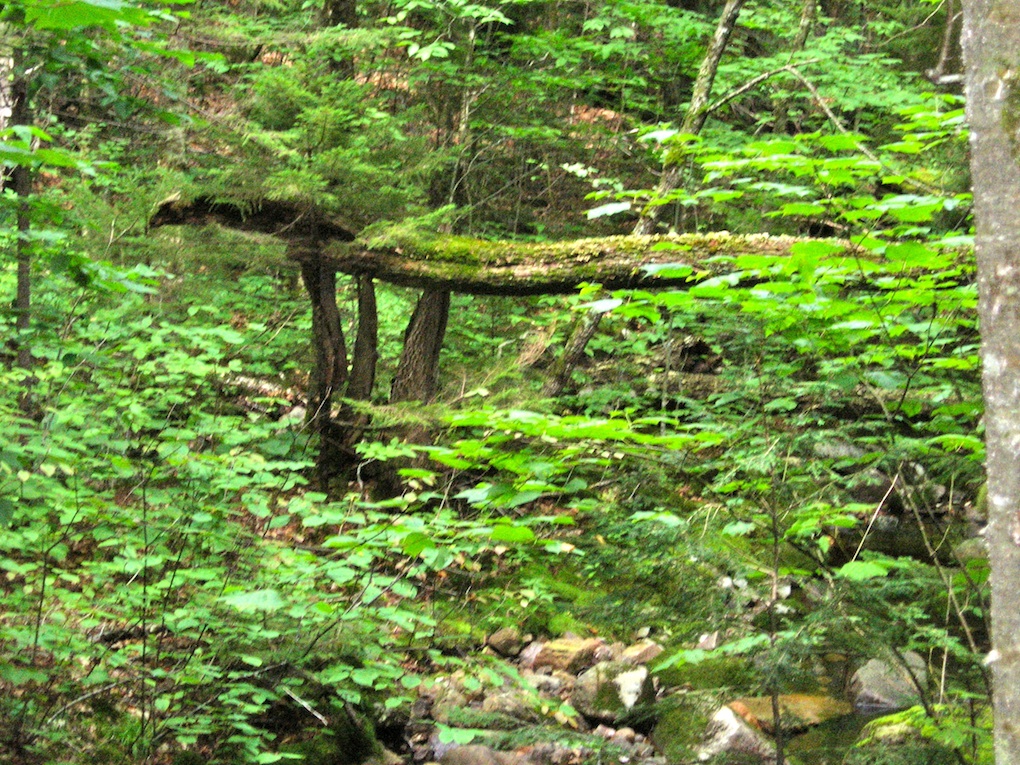
trees in peace symbol  B-18 bomber crash stie July 24, 2010


by Cheryl Suchors

30 June 2010

My First AMC Hike

by Cheryl Suchors

My first official Appalachian Mountain Club (AMC) hike after being certified to co-lead was, ironically, called “My First AMC Hike.”

Bob, the experienced hike leader who had created the concept years before, agreed to resurrect it when I said it appealed to me. Designed to attract new people to hiking and to the benefits of AMC membership, “My First AMC Hike” was a two-part hike in the Blue Hills of Milton, MA.

Houghton's Pond from website

Part I was basically flat, three miles around Houghton’s Pond and a bit of incline up to Tucker Hill to catch a view. No special gear required, just decent foot wear, a rain jacket, snacks and water.

Lots of water. When I started the trail talk at 9:15am on Saturday morning, it was already 75° and humid. The sun beat down hot enough for me to remember to slather my arms and face with sunscreen.

Bob had put in the information sheet we sent out to all participants ahead of time the little-known and unlikely fact that not only copperheads but rattlesnakes inhabit the Blue Hills. I’d encountered a rattler once in my life, out hiking in Sedona, AZ, off trail in popcorn rock, exactly where a hiker should never be. I was climbing up hand-over-hand and had just pulled myself onto a nice ledge when I heard that unmistakable sound.rattlesnake image from google website

If you’ve ever wondered if you’d recognize a rattlesnake’s rattle, trust me. It’s hard wired into the human brain. The guidebook to all the critters that could kill you in Sedona, AZ was emphatic about what to do when one encountered a rattler. Freeze. Locate the snake with your eyes. Back away slowly.

I did not locate the snake with my eyes. I did not back away slowly. I leapt off that ledge faster than a jack rabbit. My husband, who was coming up the mountain behind me was startled to see me scuttling back down. “You sure it was a rattlesnake?” he asked.

I gave him a look. “If you don’t believe me, go on up and find out for yourself.” I paused. “Just remember you’re too big for me to carry, so be sure it’s the last sight you want to see.”

The Trail Talk

AMC hikes always begin with a trail talk in which one of the leaders reminds everyone of the plan for the hike and sets out a few rules, like start together, stay together, end together.

I also gave the when-you-encounter-a-snake-that-could-kill-you instructions. Copperheads, I cautioned, were more aggressive than rattlers and often took a warning swipe at people who got too close. They cut the warning so fine that sometimes they broke the skin on someone’s leg and even that could be dangerous. “Don’t go closer to a snake to get a better view,” I said. “Don’t sneak up on it to see if it’s the dangerous kind. Don’t try to snap a picture. Just back away slowly.”

Coppperhead snake image from Google website

“Bob’s been hiking in the Blue Hills for 12 years and not only hasn’t he been bitten, he hasn’t even seen one of these snakes.” I wanted to put the risk in perspective.

I thought my first trail talk went reasonably well, but what do I know? The participants were all nice polite people.

Tracking 15 People

When one of the hikers acknowledged he liked maps, I asked him to go first with a copy of the map in hand and he graciously agreed. I hiked one or two people behind him, close enough to the front so I could keep an eye on the trail as well. Bob hiked toward the back of the pack so we could cover the whole long line of folks between us, and off we went.we start off around Houghton's Pond 6/26/10

The initial footing was easy, a path wide enough for four people abreast. As we left the perimeter of the pond, the trail narrowed some and roots showed from thousands of shoes and boots hiking the soil right off of them.

I’d expected to see a lot of other folks out walking on a weekend, but we encountered few other hikers. That was a good thing, in my book. It

was hard enough to make sure all the members of our group were still together. Eighteen people had signed up for the hike and 15 of them showed up.

There’s a lot to focus on as a hike leader besides not losing anybody and staying on the right trail. Some of our participants were beginning hikers. I tried to remember to remind everyone to drink. Were any of them getting hot spots on their feet, indicative of blisters-in-the-making? Did anyone need a bio-break? How was the pace—too fast, too slow, just right?

A hike is also a social event. I wanted to get to know each of the hikers at least a little bit so they felt welcomed and freer to say their feet hurt or they needed a break, and, besides, they were interesting to talk to. Sometimes it was hard to stop conversing to count heads.

Tucker Hill

Soon we arrived at the rocky trail, about two-tenths of a mile long, up to the top of Tucker Hill. Bob gave an encouraging speech about how everyone could hike up a steep hill, it just took time. He cautioned newer hikers not to expect to go as fast for the same output of energy up a hill. I added that many smaller steps were better for the joints and less tiring than fewer large steps. Up we went. Everyone did fine.

Tucker Hill First Hill of 6-26-10 Hike in blue Hills

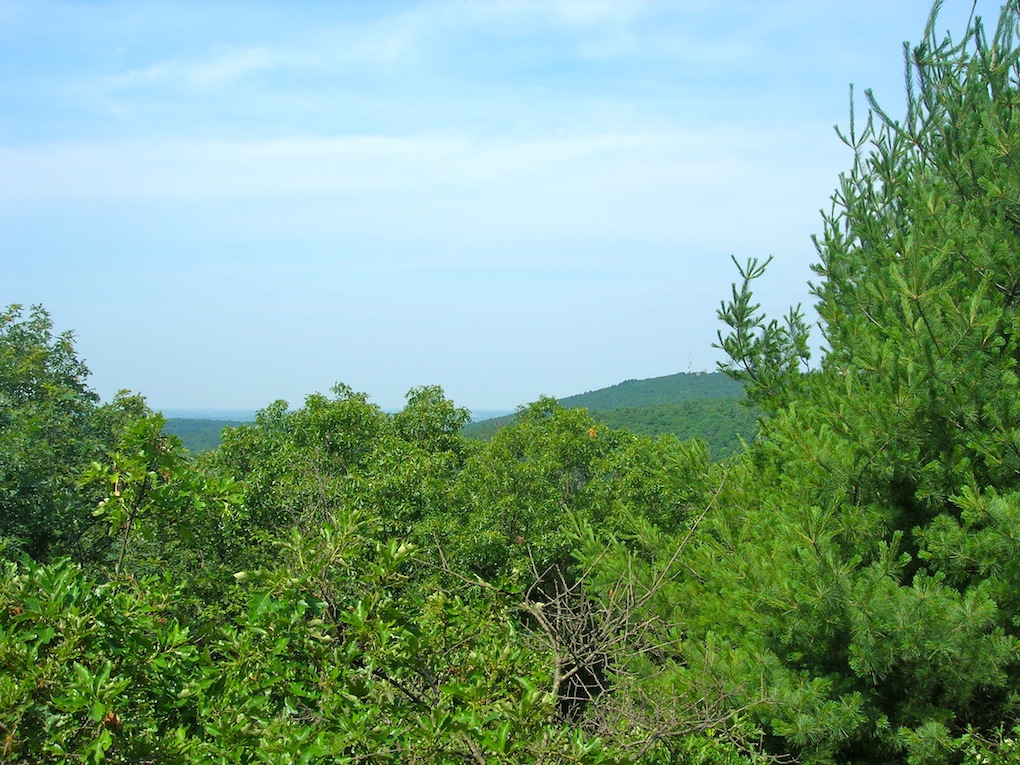
At the top was a lovely, if limited, view. We all admired it while we caught our breath. Bob pointed out the radio tower for Boston’s public radio station, WGBH, a mile-and-a-half west of us. One of the hikers, Steve, told us what the call letters stood for: Great Blue Hill. The tower perched atop the largest of the hills in the Reservation, Great Blue. I never knew that!

Heading Back

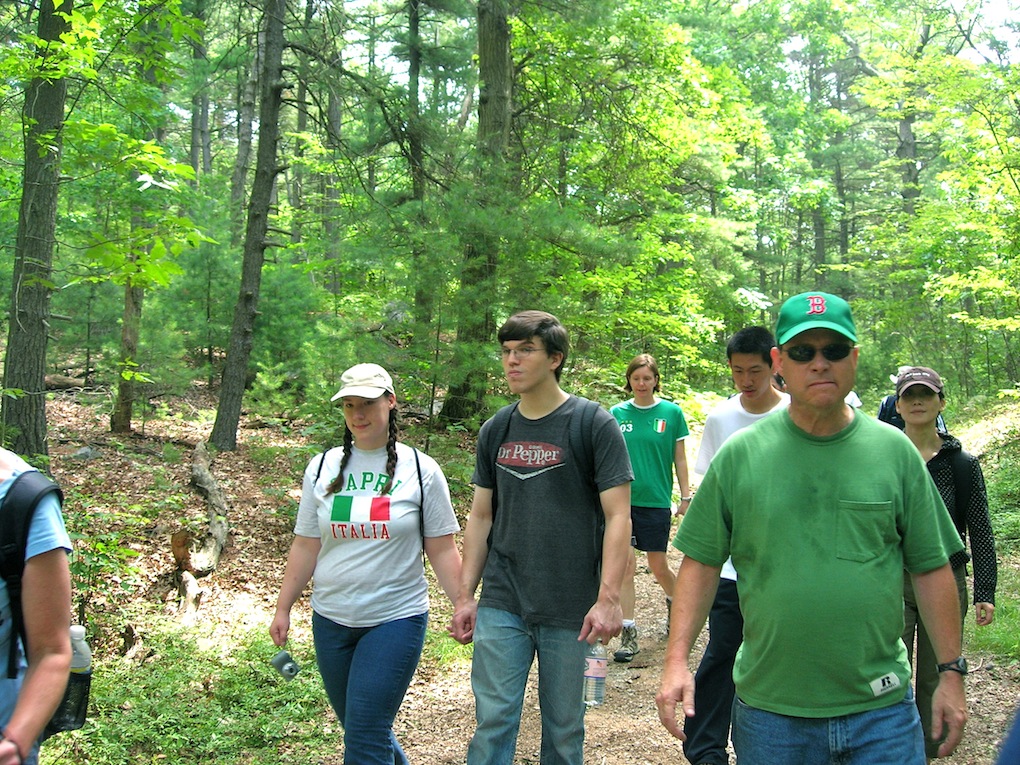
After Tucker Hill, the group naturally broke into two clusters, one faster and one slower, for part of the hike. Bob roamed from one to the other little group and, when he appeared, I’d head off to the other. That way we got to talk with and check on everyone.

At one point, Bob remembered that we’d forgotten to tell people to turn their cell phones off, always a good idea when you’re out enjoying nature. I had left mine on initially in case any of the participants who hadn’t shown up called me and then I’d forgotten it was on, so the reminder was a timely one.

We returned to our starting point on Houghton Pond and hunkered down in the shady grass for lunch. Bob dumped his pack out on the lawn and explained why he carried the various things he packed.

He shared with us a cool fact he’d learned from a scientist dedicated to improving gear for soldiers: turn your hiking socks inside out, so the fluffy part faces out. As the scientist said, “Have you ever seen a sheep, or any animal, wear their fur on the inside? Much better to disperse the heat and moisture if it’s facing out.”

Cynthia put on fresh socks turned inside out and said they felt like “an oasis of pleasure” between her feet and her boots. I can’t wait to try that myself. We said goodbye to those who were leaving and got ready for Part II of the hike.

Afternoon Hike

For anyone who had managed Tucker Hill well enough and wanted more, we’d spend the next few hours going up and down three or four more hills, taking in Great Blue, the biggest hill and namesake of the Reservation, covering another four miles. Four hardy souls stayed on. We crossed the road and hiked up Houghton Hill, which seemed a fitting way to begin since our morning jaunt had begun with Houghton’s Pond.

When one member’s bootlaces kept coming untied, Bob offered up another golden nugget: Cheryl’s Magic Knot. (Not me Cheryl, another Cheryl from AMC’s Southeastern Mass Chapter who’s a longtime member and hike leader.) Check it out.

It was hot, really hot. And very sunny. It was humid. Really humid. And sticky. You could hardly drink enough water to make up for all that sweated out of you. Our shirts and shorts were soaked. Salt caked on my face. Not one of our staunch little group complained.

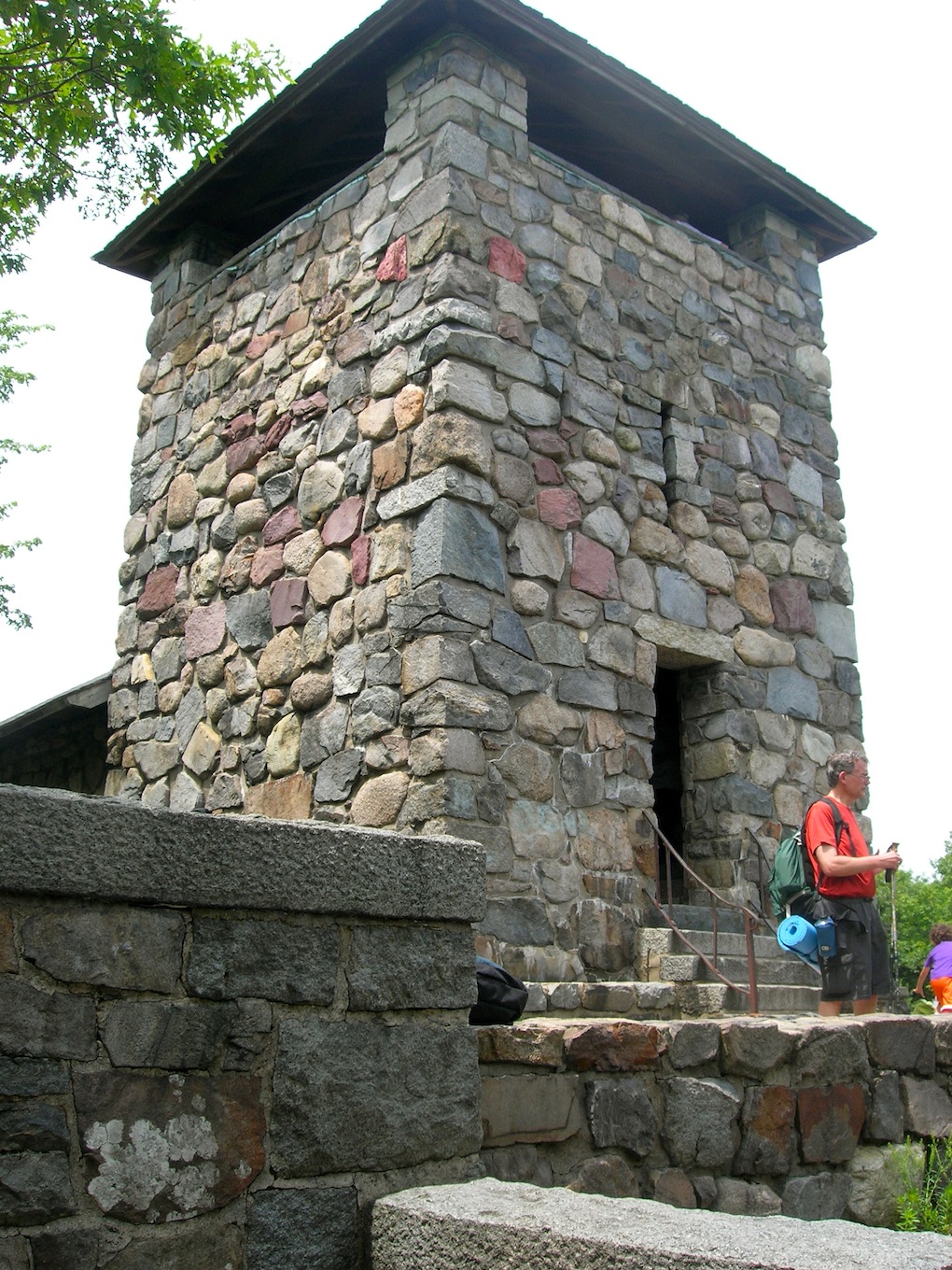
We got on to the South Skyline Trail, tramping up and down hills, till we reached the Tower atop Great Blue, a lovely stonework formation which housed steps up to the top and windows looking out over the whole Reservation.

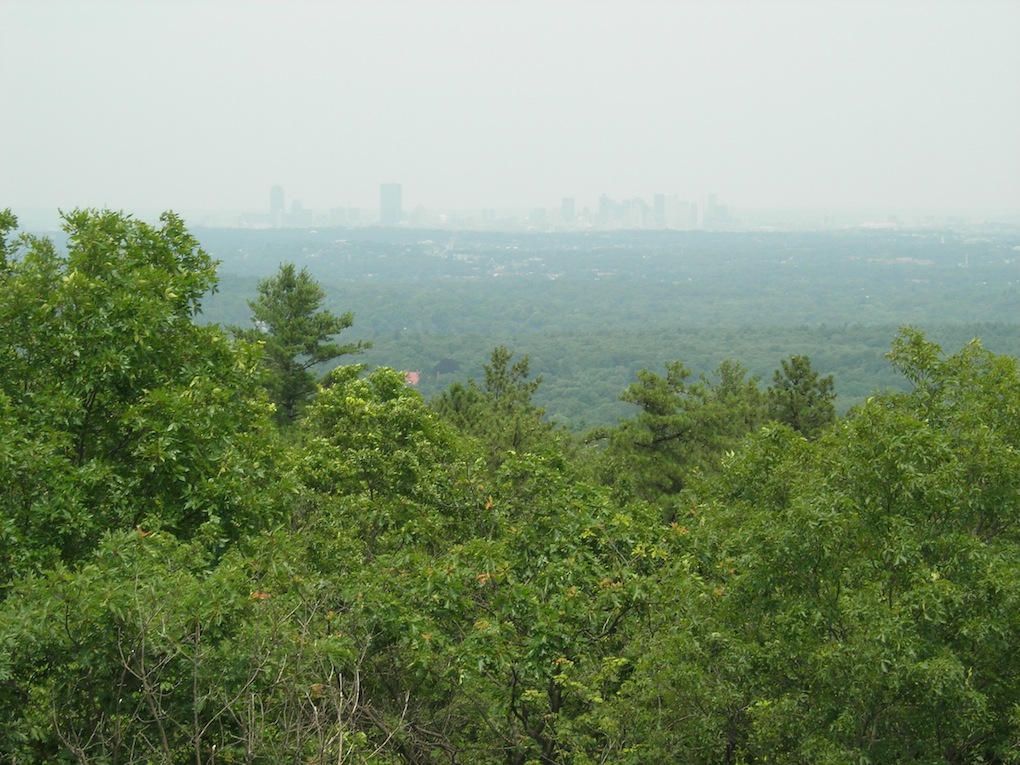
Far to the East lay Boston, a shadowy city in misty grey.

A cool breeze blew through the windows at the top of the tower, as refreshing to the body as the sight of distant Houghton’s Pond, our starting point, was to the eye.

After enjoying vista and breezes, we saddled up and hiked off on the North Skyline Trail. Fine views were to be had atop Wolcott Hill and some of the Hemenways before we turned back to our friend Houghton and sloped on down to the parking lot.

A young mother with a friendly girl agreed to take our picture, proving that not only was the Blue Hill Reservation an amazing gift of nature within eyesight of Boston but it brought out the best in people. I certainly plan to return now that I’ve had such an enjoyable hiking venture there.


—Cheryl Suchors

17 November 2009

Gradualism Isn’t Working


Former Governor Madeleine Kunin shared powerful words on the topic of “Reclaiming the Spirit of Citizenship,” especially when it came to getting more women in public office. Last year she published a book on the subject, Pearls, Politics and Power, to encourage more women to run.

Kunin served not only as the first woman governor of Vermont—elected three times—but also as Deputy Secretary of Education under President Clinton and then US Ambassador
to Switzerland (where she was born, moving here as a little girl to escape the Nazis.) Her experience shows. Not once did she refer to a note during her hour-long talk, yet she remained in command of her subject, on point and riveting.
Had she been native born, she’d have made a great President. I’m sure I’m not the first to say so.

Paltry Gains in Public Office

She’s no longer a fan of “gradualism,” the notion that the percentage of women in the public arena would rise naturally once women broke into the field. It hasn’t happened, despite the Second Wave of Feminism in the 1970s. Kunin noted that the day before the elections last November, women held 16% of elected offices. The day after the “great gains for women,” females accounted for a whopping 17%. Even if we gained a percentage point every year, it would take until 2042 for women office holders to equal our share of the population and until 2044 to hit our percentage of voters.
Text Color
What About Here in Massachusetts?

So how does the great Commonwealth of Massachusetts, that bastion of liberal values, stack up? Our US Senators are men and always have been. Of our 10 current US Congresspeople, one is a woman. That’s 10%, folks.

MA must be better at the state level, you’re thinking?

We’ve never had a woman governor. Currently, only one of the statewide elected executive offices is held by a woman, Attorney General Martha Coakley, and she’s the first woman to hold that office in the 221 years of our history.

We do better in the State House, but we have a ways to go to parity. Of our State Senators, 30% are female and women hold 25% of the State Representative offices. Liberal Massachusetts ranks 18th among the country’s state legislatures in terms of women elected.
Tied with Montana.


As Kunin pointed out, the neighboring states of New Hampshire, Maine, Vermont and Connecticut all do better by women than MA. (Check out the Center for American Women and Politics for other facts.)

How Can Each of Us Improve this Picture?

Hillary Clinton’s campaign brought forward many volunteers who told me, “I’ve never done this before.” Campaign work isn’t hard and the camaraderie amongst volunteers is amazing. I’m still friends with people I got to know during the Presidential primary and expect them to be in my life for a long time to come. (Kim Romano, the videographer doing the documentary of TOP, is one of them.)

If you can’t contribute the time or aren’t physically able to volunteer, give money, however much you’re able. In these days of Internet donations, no contribution is too small because they all add up. Join Emily’s List to help out great women candidates all over the country.

Just as important as these kinds of activism is the kind we can all do: talk to friends, relatives, and acquaintances about our candidates. Wear a button that shows your support. I’ve had wonderful conversations with strangers who come up to me as I’m out walking the dog to ask why I’m for the woman whose button I wear.

Face-to-face discussions change minds and influence votes. Trust me on this one. Governor Kunin’s talk persuaded three women I know to get off the fence and vote for Attorney General Martha Coakley in the race for Ted Kennedy’s Senate seat.

Run for Office

If you have the slightest inclination to run for office, read Gov. Kunin’s book, Pearls, Politics and Power. Go to the Barbara Lee Family Foundation website, sign up to be on their email list and get all of the studies they’ve published about how women get the keys to the city, the state and, someday soon I hope, the country. Meet Ms. Lee, an amazing dynamo who raises funds for women candidates. Get in touch with Emily’s List, a national fundraising organization that supports pro-choice Democratic women running for Congress or governor all over the country.


However you choose to do it, feed the flame of citizenship inside you. For your own sake, for other women, and for the country you love.


—Cheryl Suchors

10 November 2009

Who's A Feminist Today?


In her response to the topic “What Is The Evolving Meaning of Feminism?” Jaclyn Friedman told us that she—at 38—bridges the gap between older feminists who say, “Where are the young women? Why aren’t they feminists?” and younger feminists who say, “Why don’t the older women support us?”

There are young feminists out there I’m not supporting? Please tell me where. Many other Second Wavers and I are eager to join forces with them. Friedman said because younger women don’t do feminism the way we of the Second Wave do, we tend not to find them. They’re on the Internet.

So I went to the Internet. I checked out Feministing.com, a place Friedman recommended and that must get a lot of traffic. First thing I looked at was their mission:

Young women are rarely given the opportunity to speak on their own behalf on issues that affect their lives and futures. Feministing provides a platform for us to comment, analyze, influence and connect.

I’m down with that. Sounds a lot like TOP. Except we meet face-to-face on Thursdays rather than connecting mostly on line. Is that the only difference between young feminists and me?

Approach and Images Differ

The first thing I noticed on the website was the logo: black cutouts of women with simplified outlines accentuating breasts, hips and hair that made me think of the trailers for the Charlie’s Angels movie popular with middle-schoolers at the turn of the millennium. The logo also looked like some of the figures cavorting through the title sequence of old James Bond movies. (That’s the second time I’ve referred to Bond in two blogs; is it me or something in the air when the subject of feminism comes up?)

Feministing creators call their logo “the mud-flap girl” and it’s meant to be ironic because she’s raising her middle finger (oops— I interpreted that as an adamant index finger) and they’re taking the image back. I’m more open to this kind of tactic than I once was (see earlier November blog Virgin or What?)

Language Differs

The Feministing site uses contemporary terms—“you guys” and “girls”— referring to women that feel like a poke in the eye to this Second Waver. Along with others, I spent years training colleagues in the business world, friends, relatives and lovers to say and write the radical word “woman” when referring to a female human older than your average high school graduate.

But I also learned a term—cis-gendered—that refers to a group I didn’t know I was in! Cis-gendered people are comfortable in the sexual identity they were born with, unlike trans-gendered folks. (Cis is a Latin prefix used in chemistry for “on the same side” vs. trans which means “on the other side.”)

I applaud this term, despite its initial awkwardness on the tongue. It follows the principle of naming the majority (instead of leaving it as the unspoken norm) as well as the minority, much like “straight” and “gay.”

Evolution Includes Differences and Similarities

Maybe these differences are what my 20 year-old daughter means when, if asked if she's a feminist, she responds, “Yeah, but not like she is,” pointing at her mother. There seem to be looser parameters around language and imagery for younger feminists than the ones we set up for ourselves in the 1960s and 1970s.

It will take more exploring online and more conversations with younger women for me to come to a deeper understanding than this brief reaction to Jaclyn Friedman’s comment about bridging a divide on my behalf. I have some homework to do, and I’m looking forward to it.

I feel great hope for Second Wavers’ ability to work with today’s generation of feminists when I see things like Sarah Jayne’s blog on Feministing. She quotes her friend’s perfect description of feminism:

“…feminism is about waking up and finding yourself in a community, its about having wicked empowered sex, feeling like you can take on any challenge, build real love, and stop feeling like you are the only person who ever thought.... damn, this world needs to change...”

What feminist in her right mind wouldn’t be delighted to subscribe to that world view?


—Cheryl Suchors

03 November 2009

Virgin or What?


When you have a lecture program entitled “Throughout History, Stereotyping Women as Virgin, Witch or Whore” and the TOP Coordinator introduces it by saying today’s version of witch is actually bitch, and whore has become ’ho, you know it’s going to be a no-holds-barred kind of day.

Therese Greenfield, our first speaker, chanted in chilling tones the litany she learned as a child to honor the Blessed Virgin Mary, the primary female role model in the Catholic Church: “Mother most pure, Mother most chaste, Mother inviolate, Mother undefiled.”

Virginity is made paramount here, a standard that pits women against their own normal, natural sexuality. Yet no one, at least in the parochial schools I attended, ever asked why virginity was so all-fired important. Of all the characteristics that make for a wonderful friend, daughter, mother, sister, partner, leader, colleague, airplane pilot it certainly wouldn’t appear in my top 1000.

And what about men’s virginity? There’s no chant that encourages boys to be chaste and undefiled. In fact, the very term virgin refers to a female unless somebody’s making a joke, as in the recent movie “Forty Year Old Virgin.” Our culture suggests that male virginity actually has negative value; it’s something boys need to lose to be considered manly. Just the opposite of girls. When girls are no longer virgins, do we appreciate them as more womanly?

“Virgin or what?” Young Therese, like many girls raised in traditional religions, wondered what the alternative was. A girl was presented with an all-or-nothing proposition, as if she were a coin with two opposing sides and no choices in between.

Whores and ’Ho’s

The other side of the coin being something very bad, the Bible’s other Mary, the Magdalene instead of the Virgin Mother.

“It’s the oldest profession,” people say with a smile. Personally, I’ve never understood this. Wouldn’t hunting or fishing have come earlier? I mean, really. How about farmer or fruit picker? Maybe when people talk about the oldest profession, they only mean for women.

Okay, I can go with that. I repeat, shepherd, farmer, fruit picker.

Or how about mother? Wouldn’t that have to be the absolutely oldest profession? Or doesn’t child rearing count as a job?

But back to whores. Or ’ho’s, as so many girls and women are called in rap music and high schools and, probably by now, middle schools too. A girl seems to be a ‘ho if she talks too much to your boyfriend, or even a boy who isn’t your boyfriend but you have your eye on. So if she’s a whore with your guy but no money has changed hands, does that mean any girl with a boy is a ’ho —even, perhaps, you?

No, that can’t be right. Let’s try that again.

She’s a ‘ho because she’s stealing something, a boy, that belongs to you. You don’t call her a thief because sex is involved somehow and besides, you really want to disparage her because she’s got or might get your guy. (Apparently, this boy is stupid and powerless enough he can be taken. Otherwise we’d blame him. Wouldn’t we?)

’Ho is, admittedly, much more insulting than thief. A thief, after all, could be a boy, or even a man.

From the male perspective, a female is a ’ho if she rejects his advances, prefers another guy, or whenever she leaves him or does anything else he doesn’t like. Almost as if someone must have paid her not to want him or to obey his wishes. Is that where the prostitute part comes in?

W.I.T.C.H.E.S.

Kate Clifford Larsen, our second speaker and author of Bound For The Promised Land, made it clear that throughout history, women who rebelled or couldn’t be suppressed—or who inspired jealousy for whatever reason—were labeled witches. They were brought to trial and, often, murdered.

When I got home after the lectures, I went straight to one of the most rebellious texts I know, Mary Daly’s Wickedary, a send-up of Webster’s written with Jane Caputi. The book defines words from a female-centered perspective, reclaiming labels meant to dishonor and put down. Witch reverts to it’s original meaning of a strong, knowledgeable woman, to which the authors add: “an Elemental Soothsayer; one who is in harmony with the rhythms of the universe: Wise Woman, Healer,” and more.

In the 1970s and 1980s some feminists even adopted the acronym “W.I.T.C.H” for their organizations. One group called themselves Wild Independent Thinking Crones and Hags. Now there’s a group I’d like to be part of!

Hold up.

I already am part of a group like that.

According to Wickedary, a hag is a woman who sees through the oppressions of patriarchy, exposes fools and calls women into the wild, bountiful land outside patriarchal thinking. Crones are those who have survived the “perpetual witchcraze of patriarchy”, women who’ve discovered their own depths of courage, strength and wisdom, the highest order of hags.

If that isn’t TOP all over.

From Rogue to Bond

When Kate announced we women collude in stereotyping other women, I felt the tension rise in the room. What woman here, she asked, had never called another female a bitch, for example?
Men don’t seem to do this to each other. She took us back to colonial times when men who had sex outside of marriage were labeled rogues, a term of scorn and dishonor. But the label didn’t stick.

My guess is men didn’t use the term on each other enough. As early as 1750, it was no longer such a bad thing for men to enjoy sex outside of marriage, though of course it remained so for women. Today, though a whore is still a whore, a rogue may be kind of an interesting guy, even a sexy-looking, all-powerful James Bond.

How does this happen throughout history, with words and values and stereotypes? I think derisive labels and attitudes stick to women more than men because:

· People in power do the naming
· Naming adds to power
· People who feel powerful refuse to be shamed
· People without power get named, blamed and shamed

Will Women Choose to Name Themselves?

How can women grasp the power to name themselves? Wickedary offers us one way to take back old, venerable terms that have been co-opted. The authors create empowering new meanings for modern-day insults.

Is that the way to go?

My friend Lyn claims the label bitch proudly. “It stands for Beautiful, Intelligent, Talented, Creative Human,” she says. Maybe she is right. Maybe that’s how demeaning terms slide off men like so many raindrops; they refuse to be made to feel less-than. Fine, they say, call me a rogue. I’ll go you one better: I’ll be a rogue.

Hmm. Maybe the next time I’m called a bitch, I’ll thank the person and tell him/her why. Dare I pass the compliment on to other women after so many years of refusing to say the b-word? But imagine if we women called ourselves—laughingly, lovingly, proudly—bitches and witches, whores and ’ho’s and whatever other derogatory terms have been invented for us. Wouldn’t we defuse any attempts to demean, shame and control us?

Or, if that approach doesn’t appeal, what if we created positive terms for strong women and sexy women, smart women and courageous women—and never used those names for men, but just flooded the language with wonderful words for everyday women?

Whatever women choose to do to slough off denigrating labels and the attitudes behind them that hurt real women, whether we laugh at insulting terms or invent words that affirm women or use both approaches at once—let’s do it together.

—Cheryl Suchors

27 October 2009

Hostility Holds Up Women & Progress


Concrete Ceiling
Susan Eisenberg, master electrician, author of We’ll Call You If We Need You, talked Thursday about the hazards she and other women faced in the construction trades from men who wanted them off the job: explicit sexual graffiti, stolen tools, not being assigned to jobs, being thrown down staircases, shoved or even raped. Eisenberg was taken off a job for her own safety after she protested against a party that would bring a stripper to the site.
She eventually quit because she couldn’t keep paying the price to do the job she’d trained so hard to do. The trauma continues; she’s blocked out some of the abuses she endured because they’re so painful to remember.
No wonder that, despite the fact that women comprise nearly half the U.S. workforce, only 3% of construction workers are female. They can’t break through the concrete ceiling to make it out of the basement.
Glass Ceiling
These figures from the blue collar world sounded eerily familiar. In the white collar world of large accounting and consulting firms where I worked in the first half of the 1990s, roughly 3% of the partners, the people at the top, were women. And yes, you guessed it. Close to 50% of entry level hires were women and had been for over a decade. Women had made it up from the basement to equal employment at the lowest levels, but the higher echelons remained hidden behind cigar smoke.
I joined a team of facilitators who trained partners and managers of one of these large firms to look at what created the glass ceiling. I’ll never forget one man, a partner in charge of an office, who’d been through our workshop twice. He said he finally understood that women rarely succeeded in the firm because “the environment was corrosive to them.”
Whether the form of corrosion hurts a woman’s body, her psyche or her chances to manage the big accounts, it still eats away at her. Eventually, she leaves.
What It Takes To Drill Through
In the 15 years since that accounting firm with thousands of accountants, lawyers and consultants began their Women’s Initiative, they’ve increased their percentage of women partners to nearly 20%. Top management committed to concrete, consistent actions to change the culture that held women back.
They hired outside experts to train management from the top down. They changed performance reviews and created specific mentoring systems to make sure women were, unlike most of Eisenberg’s electricians, apprenticed to experts. They made sure the men who took colleagues and clients to strip joints were stopped.
It took years, money and hard calls when the backlash against all the attention paid to women turned some men more obviously hostile. The other big firms, to stay competitive, have tagged along and the industry’s clients, as well as women, have benefited.
What will it take for one trade, perhaps electricians, to realize they’re hurting themselves by shutting the door in women’s faces? How can they do the best job or progress toward the future when half the population is excluded from the talent pool? What union will be farseeing, ethical and strong enough to level the playing field for women?
These are important questions for the construction industry now scheduled to receive major infusions of stimulus money. I wonder—why not tie the funds to cleaning up the toxic environment for women in the trades?
—Cheryl Suchors

25 October 2009

Introduction

Welcome to TOP's brand new blog!

Cheryl Suchors is now taking on the task of writing a blog on the topic of the week, starting with how we might respond to bullying. This will be followed by postings on the stereotyping of women and the evolving meaning of feminism. We look forward to hearing what she has to say. We are hoping to stimulate a lively discussion around these issues and that the blog will provide a forum for the women of TOP and the wider community. So if you want to add your two bits to what Cheryl has said, please post your comments.

Susan Nulsen