13 October 2010

Halloween — Pumpkin Carving Instructions

A piece of American culture, for those who have never participated before.


You will need
 your pumpkin (I bought one for $6, but prices vary) – larger pumpkins are easier to carve. Mine is about 12 inches or 30 cm diameter. (A little bigger is a lot heavier.)
 old newspaper to work on
  a kitchen knife with a long sturdy blade to cut the lid, and a large strong spoon to scoop the seeds and pulp from inside and to thin the walls (1 inch or 2.5cm is ideal). Hold the spoon by its bowl to get better control while scooping, and avoid bending the handle!
 a serrated pumpkin saw for cutting through the flesh and skin. You can find them at at CVS, Target, or a grocery store (individually or as part of a set) for approximately 2-5$. The alternative is a thin serrated knife or a steak knife. The serrated saw or knife is the most important thing. The scoop from a set is also useful.  For example:
 some large ziplock bags or large yoghurt containers for your pumpkin seeds and flesh (which is not very edible) if you want to keep them.
 some old supermarket bags for the discarded bits of pumpkin and soggy newspaper.
 some patterns, or you can do your own design
 some push pins to transfer the patterns to the pumpkins
 some tea candles to light your pumpkin.

Here are some basic instructions:

Carving:
Place the pumpkin on newspaper for easy cleanup.
Cut a circle around the stem of the pumpkin, using a knife with a long sturdy blade. Leave a large enough hole to easily insert your hand. (Make the cut at an angle to keep the top from falling through when you place it back on.) Use a back and forth sawing motion to cut through the tough skin and thick flesh. It is possible to break a knife if you are not careful.

Use a large spoon, holding it by the bowl, to scrape out the pulp and seeds and to thin the walls to about an inch (2.5cm).  Cleaning and thinning can be messy.           


Don't throw out the seeds if you want to roast them.
Before making that first cut of the jack-o'-lantern's face, study all sides of the pumpkin to find the smoothest side.
This year, for the first time ever, some creature (a squirrel?) has been nibbling at my pumpkin.  I'll have to make sure my design cuts out those places.
Draw the design on a piece of paper or print out a jack-o'-lantern carving stencil.
Tape the paper to the pumpkin, then transfer the design onto the pumpkin by punching through the paper into the pumpkin flesh with a large nail or a push pin.
With your pumpkin saw, or a sharp serrated knife, cut out the design using the punched holes as a guide. Remove the cut-out pieces by pushing them out from the inside of the pumpkin.
The finished result is ready to be lit on that most eerie of nights!  


When you light the candle inside the pumpkin, remove or tilt the lid to allow the hot air to escape.  
(Who knows, if you place your lit pumpkin outside your door as night begins to fall, you might answer a knock to some ghouls and goblins, or spiderman and a fairy princess, who can only be appeased with Halloween candy!  Maybe not in the era of covid?)


Preserving the cut pumpkin until Halloween
Unfortunately pumpkins rot, and much faster when they have been cut, so delay cutting until as late as possible.
If you cannot find room in your refrigerator, try to keep your pumpkin outside in the cooler air.
Vaseline (petroleum jelly) smeared over the cut surfaces will slow down the rotting.

Cooking the seeds:
Rinse the seeds, removing pulp with your fingers. Drain, spread out and allow to dry overnight.  The picture shows the final rinse of the seeds in a bowl of water.
                                
Bake seeds about one hour at 250F on oiled oven tray, tossing every 15-20 mins, until golden brown.
Microwave: Heat a tablespoon of oil in a suitable baking dish for 30 seconds. Add seeds, toss to coat with oil and spread over bottom of dish. Cook on high for 7 to 8 minutes until golden brown. Stir every two minutes and watch closely.

When they are cooked you can eat the seeds with the shell, which is quite tough. Shelling them is slow work but the seeds will be more palatable.

06 October 2010

Yang and Yin of the Wired World

Cynthia Wickens Gilles

I am forever seeking balance in the increasingly complex system of life. Some of you may recall my first TOP talk in November 1996, when I was anticipating potentially fatal surgery. My topic then was “Asking the Question: What Do I Want To Do With The Rest Of My Life?" Today, in an era of extremely rapid change catalyzed in part by our wired world’s amazing evolution, I am addressing that same question from the following perspectives.
Time limits: How long will we live? How can we best make a positive difference in our worlds, remembering to relish being alive, fulfilling our responsibilities, and caring for ourselves and others?


Priorities: What are our priorities in life? Do we consciously choose to allocate our time according to these priorities?

Decision making and mindfulness: How do we decide and to what extent are we usually mindful of these decisions?

Our lives are complex systems: Our life choices are influenced by their context and purpose as well as our priorities and time limits. What things are most important for our decisions?

__________________________________________
All men should strive to learn before they die what they are running from, and to, and why.

James Thurber
__________________________________________

Balancing potential benefits versus potential costs is increasingly challenging in our complex Wired World. My choices in this world have been influenced by the context of my personal life as well as by knowledge gleaned from diverse sources. My Wired World choices are unique but my questions may pose challenges for others as much as they have for me.

I have more time available now and try to exercise my well earned right to spend more time on myself, despite my long lists of things to do. But I have been a single parent of an adult son with special needs for over 30 years. He continues to become more independent and is a big help in many ways but still needs considerable support and attention. I am responsible for managing our four bedroom home, finances, etc., and other family relationships. I will be 79 in December and need to devote much more time to multiple health needs. I have nearly died six times in the last 50 years and have had two reminders of approaching mortality this year: successful surgery for a breast cancer that was only a 2 on a scale of 1-10, and a one day hospitalization this month for something that may or may not be a serious heart concern. Although my pace of life has slowed, I tend to be distracted more easily and must work harder on being mindful in order to combat creeping CPA, otherwise known as continuous partial attention.

In the department of technological innovations, I am a relatively slow adopter. For example, during the first ten years after I returned to paid work in 1970, I always found a willing secretary to do my typing. My baptism of fire came when my Federal grant proposal for an AIDS Discrimination project was funded. My interagency Board of Directors could not believe how ignorant I was about choosing computer hardware and software, so they chose for me. The attorney I hired for the project and the IT coordinator at our host agency instructed me and I discovered the blessings of computer cutting and pasting. They taught me so well that I was able to type our successful second year continuation proposal unaided!

Considerations that Influence My Wired World Choices

The Wired World has many branches. I prefer to use a limited number of them selectively, as tools to achieve purposes I care about. These include communication, maintaining connections and relationships; collecting, storing and sharing information; researching diverse topics; advocacy and networking; planning and coordinating; writing and other creative arts; continuing education; and recreation. Unfortunately, these beneficial uses can be accompanied by potentially harmful side effects that I prefer to avoid. And my decisions are influenced by emotions as well as reason.

1. Relationships: Intimacy and Trust versus Distance

Relationships can satisfy a basic human need for connection, but their quality is of critical importance. How do you define friendship? I believe that most real friendships take time and effort and face to face conversation to develop trust and intimacy. On Facebook, the number of friends appears to greatly outweigh the quality of relationships in members’ weighting scales. Social networks seem to help people become more interconnected but actually tend to decrease intimacy and community. Friendship needs face time as well as Facebook. Face -to-face contact has far greater impact than any online networking for friendship, politics, advocacy, organizational development, and other purposes. I often see friends and families dining together, or people walking together, with each person separately engrossed in an electronic device. Virtual relationships can keep us from developing real relationships with people who are physically present.

What fuels this need for constant “hyperconnectedness?” It can be a way to escape feeling alone. As Tufts senior Charlotte Steinway recently noted, “The tragic, isolating thing is that we reach for our devices because we don’t want to seem lonely – which is causing us to avoid our peers and actually be lonely.” Texting and talking on an electronic device sends a message to the world that I am not alone. Some people become so involved in their private virtual worlds that they seem unaware of the real world around them and exhibit very rude behavior. And I suspect that some people use these devices to help them feel important as they walk down the street or sit in meetings and ignore the speakers. Of course, some of them may just be addicted!

2. Information Access and Overload

Do you have enough information, just enough, or too much? How many of you think we can’t have too much information? How do you decide who or what to trust? Being able to locate needed information is a great benefit but we are constantly in danger of overload with too much information, often of questionable accuracy and value. To limit information pollution, we all need the Snopes fact-checking website to sort out truths from untruths. Unfortunately, the site has limited scope and its’s managers think that the truth doesn’t stand a chance versus gossip. People can say anything they like without any level of accountability or authentication. Of particular concern are the myriad viral cultures spawned by the Wired World, with their ability to rapidly circulate vast amounts of misinformation.

In contrast, the increasing ability to access and exchange vast amounts of information is contributing to great strides in science, the arts and other realms of knowledge and creativity. And social networks can offer both advantages and harms, depending on their use. With so many information sources available , it is easier to stay with some relatively familiar ones that we consider trustworthy and otherwise desirable. Although I am grateful for the many educational resources available electronically, and enjoy collecting and sharing information, I am mindful that some uses of my time are far more valuable to me than others.

I am minimally signed in on Facebook but decided for personal privacy reasons that I did not want to include a large amount of personal information.– My arthritis fortunately prohibits using Twitter but limited exposure to a small sample of tweets by newspapers, radio and TV suggest I haven’t missed much. – It would be hard to avoid having a Blackberry or similar device if I were still gainfully employed or job hunting, but I am not. Blogs have created a modern Tower of Babel, the whole world talking to itself with many anonymous voices of uncertain quality and value. Even without using these networks, I have access to more information than I need, often the same information from multiple sources - too much already!

My favorite media choices include newspapers, radio, TV, the Internet, magazines, newsletters, and limited TV. I love the look, feel, and smell of newspapers, the ease in scanning pages to find articles of interest. Newspapers are often the best sources of quality journalism, though this is under attack. Reading newsprint is easier for me than reading a computer screen. I delight in scanning the paper while enjoying a cup of coffee at my kitchen table. And I also enjoy trying to stay informed about current information on health and other policy issues using all of the above media. – Electronic media have enabled me conduct some valuable personal research, most recently on several related health problems and medication side effects. Ease of online communication with my physicians also is convenient but I feel rather guilty about being on the benefit side of economic and literacy inequalities that cause disparities limiting access to the Wired World for many people.

3. Mindfulness versus Multitasking

I agree with Mary Oliver that you need to live a good part of your life fully engaged with the real world and people around you to feel alive and happy. Time is life. But being fully present requires a level of mindfulness that can be hard to maintain in the face of distraction overload and resulting continuous partial attention. We really can pay full attention to only one thing at a time, and it takes time to shift from one focus to another.

Recent Stanford studies found that multi-tasking is inefficient and overrated. People who do more multitasking are more easily distracted and less able to ignore irrelevant information than people who do one thing at a time. They also understand less and are less creative and productive. Constantly shifting attention impairs both in-depth learning and retention in memory, and also can impair higher cognitive functions such as effective decision making. Neuroscientisit Eric Kandel observes that only when we pay deep attention to a new piece of information are we able to associate it “meaningfully and systematically with knowledge already well established in memory.” And for me, this becomes harder with increasing age.

Hand held devices offer many benefits, such as coordinating with others, being able to call for help, and being able to work in many different places. But using them while walking as well as while driving can be dangerous. And some new research suggests that cell phone use impairs drivers’ ability to recall information in cell phone messages, and also challenges the idea that conducting important business conversations while driving boosts productivity.

Tony Kamaroff perfectly captures my feelings about distraction overload. He says,”I refuse to use a smart phone. In a world that’s already pulling me in 10 directions at once, I don’t need to be pulled in an 11th direction. I don’t want to be interrupted every few minutes by a signal that says there is a new message for me, because my personality is such that I’ll stop what I’m doing and look at every message. And forget what I was doing just before I got the message. And go crazy trying to remember. And going crazy is not good for your health.”

4. Wired World Devices as Tools versus Traps

Electronic devices and other technology can cause distraction, interruption and addiction, change the way we think, and devour our time, but this all depends on how we decide to use them. I try to remain mindful of the differences between using and being used by electronic media, between independent access and addictive compulsion. I am curious about many things and try to keep well informed and continue to explore and learn, but I have to discipline myself to avoid spending too much time on media.

Electronic devices build invisible walls between us and the people and natural world around us, and it is not just because of work-obsessed lives that demand we be on call 24/7. These devices are fearfully addicting and this is an international problem. South Korea recently classified 2 million of its 49 million citizens as “Internet addicts.” Even
feeling obligated to check all of one’s e-mail and respond promptly to every new message can be a problem. The Internet is loaded with addictive opportunities. Commercial websites are designed to make shopping easy. Even e-Bay has its addicts. I am pleased to have cultivated my ability to ignore intrusive ads which saves not only time but money!

5. Security and Privacy versus Vulnerability

Cyberspace presents personal dangers as well as opportunities. Social networks all carry security risks. Sam Allis has wisely observed that “Once you buy into text messaging and/or e-mail on a cellphone, you’re doomed. You’re always available. You can’t hide. You’ve lost any semblance of a private life. Call it the revenge of technology.” Some dangers are local, national, or international in that cyberspace lends itself both to planning and to trying to foil terrorist and other attacks. We are constantly subjected to a frightening amount of unseen surveillance, not only by governments, but also by many commercial entities, and undoubtedly others as well. And once they have found us, they have few reasons to let us escape their scrutiny. Because I believe that surveillance of our personal information is much broader than most of us can imagine, I will continue to minimize my involvement with social networking sites.

Erving Goffman observed that, “Among all the things of this world, information is the hardest to guard, since it can be stolen without removing it.” Theft of personal and commercial or proprietary information can pose major problems. And I do not entirely trust digital records. They can be accidentally erased or be contaminated by viruses. Hard drives die and Internet providers can vanish, temporarily or permanently. Also, the galloping electronic evolution is hastening hardware and software obsolescence. I have two hard copies of my 1982 doctoral dissertation but am still seeking someone who can transfer it from old 5¼” floppy discs to newer accessible media.

6. Impacts on our Brains and Health

I also am uneasy about some other potential effects of the Wired World on my health and cognition. Several sources, including Nicholas Carr’s recent book, The Shallows: What the Internet is Doing to Our Brains, raise some serious concerns, that the internet may be reshaping our society and our brains in ways that make it more difficult for us to concentrate, to remember, and to think deeply and critically. And some cognitive neuroscientisits believe that the reading brain is slowly becoming endangered.

James Carroll argues that soundbites reduce experience to fragmented episodes without the context essential to understanding. He also believes that PowerPoint presentations, with their shorthand organization, can create the illusions of understanding and of control while inhibiting actual thinking. Brigadier General H.R. McMaster says that “Some problems are not bullet-able.” So consider discarding the laser pointer and just talking to people!

Bill Wasik, an analyst of the rising impact of technology on everyday living, observes that “the challenge is to try to find ways to partially unplug ourselves, to carve out spaces in our lives away from information, away from the constant buzzing of the hive mind...a lot of creative people want to be working on their craft, they want to be thinking big about what they should be doing...but the culture is encouraging them to think small.”

I take great pleasure in the ability to choose being out of reach. I treasure the natural world, solitude and silence. Some physicians write nature prescriptions these days so I’ve been working on one of my own. This summer, I’ve enjoyed sitting in late afternoon sun in our backyard and reading or just observing birds, flowers, and the sky - or sitting in our small plant room in late evening meditating on the soothing cricket songs that vary in intensity with the temperature. Georgia O’Keefe observed that it takes a long time to see a flower. I want to take time to appreciate the natural world around me.

There are no absolutes in our wired world; ultimately it comes down to balancing benefits and harms to individuals, society, and the world, all infinitely complex systems. I have touched on some of the considerations that influence my personal choices of how to spend my time.

When she was dying of cancer, Erma Bombeck wrote, if I had my life to live over I would have cried and laughed less while watching television, and more while watching life. Mary Oliver asks,”Tell me, what is it you plan to do with your one wild and precious life?”

I’ll close with the same poem by Naomi Shihab Nye that I used at the end of my first TOP talk.

THE ART OF DISAPPEARING

When they say Don't I know you?
say no.

When they invite you to the party
remember what parties are like
before answering.

Someone telling you in a loud voice
they once wrote a poem.
Greasy sausage balls on a paper plate.
Then reply.

If they say We should get together
say why?

Its not that you don't love them anymore.
You're trying to remember something too important to forget.
Trees. The monastery bell at twilight.
Tell them you have a new project.
It will never be finished.

When someone recognizes you in a grocery store
nod briefly and become a cabbage.
When someone you haven't seen in ten years

appears at the door,
don't start singing him all your new songs.
You will never catch up.

Walk around feeling like a leaf.
Know you could tumble any second.
Then decide what to do with your time.

Naomi Shihab Nye
Originally published in:
Moyers, Bill, editor. The Language of Life: A Festival of Poets.
New York: Doubleday, 1995.

Cynthia Wickens Gilles

02 October 2010

Sanity and Solace

by ELIZABETH DODSON GRAY
The politics intensify and the clamor of campaigning grows louder as we head toward November 2nd. Where do we turn for sanity?

And as the news of home invasion murders and the Rutgers suicide from cyber-bullying fill our newspapers and television news, where do we go for a glimpse of goodness and normalcy?
 
It reminds me of the Kingston Trio song of yesteryear, "They’re rioting in Africa,/ They’re starving in Spain,/ There’s hurricanes in Florida,/ And Texas needs rain./ The whole world is festering. . . ."


Jon Stewart got it right on Comedy Central. "Where do we go for sanity?"
 
As summer turns to autumn, you could think that the only thing happening is politics and campaigning.


But look around you. What is really, REALLY happening is that the natural seasons are TURNING on their deeply habitual but daily spontaneous way from warm to cold temperatures, from green leaves to gloriously multicolor splendor spread out on the trees we scarcely notice when they are green.
 
In a world becoming more uncertain each year with earthquakes, floods, tornadoes, hurricanes and other EXTREME weather (which used to be unusual but has now become commonplace), there is still SOMETHING regular and steady and "normal" and "good" in our lives. It is our human context WITHIN the natural world of our planet’s biospheral cycles.


We are ENCIRCLED by the steadiness and the goodness of nature, made vivid even to our "unseeing" eyes, by the turning of the seasons.

No matter who gets elected, no matter who- kills-who in international wars and drive-by shootings, the sun will still rise. And the day will begin. And the season will turn from summer to autumn. And we will be blessed by the abundance of the earth UNTIL in our infinite human hubris and our blind technologies, we figure out a way to kill the planet!
  
But until then, open your eyes and open up your soul, to rejoice in the wonder and the blessing of the turning of the seasons. The natural seasons may possess the sanity and the solace we all need. 

—Elizabeth Dodson Gray

25 September 2010

Sing and Weep

On Thursday 23rd September 2010 in Lindsa Vallee's talk focussing the issue of HOW CAN A CULTURE HAVE RESILIENCE? HOW CAN WE DEVELOP IT?” she quoted Martin Prechtel:


In Mayan the word for song and weep is the same. “.. everything must weep/sing ….. grief and praise sleep in the same bed …. to praise is loving what is alive and to grieve is for what has been lost ..”

05 September 2010

25 Years of TOP

Here is a republication of the press release issued on the occasion of TOP's 25th Anniversary in 1998. Read this to see how TOP has evolved and continues to evolve to meet the needs of the women it serves.
Celebrating the 25th Anniversary of TOP
— by Elizabeth Dodson Gray
One of the Divinity School’s unique programs, known as the Theological Opportunities Program (TOP), is celebrating its 25th anniversary this fall of 1998.

To celebrate their 25th anniversary the Advisory Committee has planned an exciting fall lecture series entitled "This Is The Time For Women," with major lectures by Federal Judge Nancy Gertner, Jill Ker Conway, Clare Dalton, Jean Baker Miller, Christiane Northrup, Elizabeth Dodson Gray and Carolyn McDade.
The anniversary series this fall begins Thursday morning, September 24th at 10 AM in the Braun Room at the Divinity School.
TOP WAS BEGUN IN 1973 by Brita Stendahl and a committee of interested women. At that time it was a reformulation of the earlier "Ladies Lectures" (lectures on Thursdays in April), which began in the late 1950s during the deanship of Douglas Horton.
In 1973 the lectures were redesigned as a spring and fall Thursday morning lecture series, intended to appeal to all those who were seeking and searching for just what the title says, "theological opportunities" in their lives and in their thinking. To the lectures were added mini-courses, taught by HDS faculty and only available to TOP participants, to provide for deeper and more intense theological reflection and inquiry.
It was a gateway for laywomen into the Divinity School, and numbers of women in the years since 1973 have gone through this gateway into regular enrollment as students at HDS.
Through the years, the mini-courses faded away, but the lecture series every fall and spring have grown in the fall from 4 sessions to 8 and in the spring to 10 or 11 sessions. The Advisory (planning) Committee, led since 1978 by its coordinator, feminist theologian and author Elizabeth Dodson Gray, has grown from a small committee of 10–12 to its present strength and diversity of 45–50 women. It is open to all who choose to join in the planning Thursday on afternoons after the fall or spring lectures.

THE LECTURE TOPICS HAVE SHIFTED from more conventional and traditional religious inquiries to questions that arise out of women’s life experience, for example, from "The Dynamic God and the Transformation of Biblical Symbols" to "What Does Love-As-Self-Denial and Love-As-Sacrifice Do to Women?"
During the deanship of George Rupp the Theological Opportunities Program was encouraged to find its speakers (there are no honoraria) from the wider Harvard community as well as the Greater Boston Area, looking for speakers to lawyers, legislators, authors, environmentalists, psychologists and psychotherapists as well as to academic professors and theologians.
Attendance ranges from 90 to 160 people for each lecture. There have been visitors from Iceland, Japan, Pakistan, Jamaica, England, Holland. Registration data shows that more that 1700 different women and a few men have attended in the last 10 years, and it is estimated that between 3500 and 4000 attended in TOP’s first twenty-five years.
In connection with the 10th anniversary series in 1983, the position of "existential focuser" was developed. This is a short (15 minute) speech which precedes the major lecture, and its purpose is to root or ground the topic of the morning in the life of one woman from the planning committee, who can speak about how that morning’s topic has been crucial, for good or ill, in her life.
After the major lecture, there is a question period, a short break at noon, and then a participatory discussion so that all who attend can have an opportunity to share their life-experience on this topic. Occasionally the subject of the morning is illuminated through a panel of 3 or 4 speakers who can witness to the diversity of perspectives on this question.
Because the morning experience, which begins at 10:00 AM and lasts through 1:00 PM, has a variety of speakers, questions and discussion, the morning is now best described as a half-day conference, and the 1998 fee is $10 per session, with a 20% discount for series subscribers.
The planning of the lecture series is at the heart of the TOP program, but through the years the creativity of TOP has generated other manifestations of its life. First came the support group which meets every Thursday morning when there is not a lecture, both summer and winter. This small, more intimate group has a "go-around" ritual, which encourages each woman to focus on the question, "What am I feeling about my life today, or this week?" The support group has itself initiated a process of telling Spiritual Journeys to one another.
But the generativity of the group has also birthed a monthly Sunday afternoon discussion group, Conversations Over 50 (only over-50 can attend), which focuses on the unique questions which women in their 50s through 80s have about their lives. Out of this Conversations group came for a time another smaller discussion group about "End-of-Life Decisions."

IN 1988 THE TOP GROUP WROTE ITS OWN BOOK, Sacred Dimensions of Women’s Experience, based upon the fall 1985 lecture series of the same name. Co-written with articles by 29 TOP women and friends, edited by coordinator Elizabeth Dodson Gray, and published by Roundtable Press, the book has been hailed as a significant milestone in feminist theology.
The Very Rev. Dr. Lois Wilson, then one of the presidents of the World Council of Churches, wrote: "Sacred Dimensions of Women’s Experience is an important book. It is one of the few theological books I know that addresses the meaning of the sacred out of the experiences of women. I could hardly believe it when I went through the index and found ‘myself’ there, having experienced (along with other women) housework, falling in love, giving birth, caretaking, raising children, creating a home. Naming the sacred in our own experience is an absolutely essential theological task for women." On the book cover, as lushly vivid colors swirl around, the words of Rosemary Radford Ruether are quoted: ". . . we are engaged in a new revelational encounter with the divine in and through women’s experience. . . . "
One participant, Priscilla Hinckley, has written: "Two important things happen at TOP: (1) lay women bring their issues of spiritual concern arising out of daily life to the Divinity School and explore them with students and professionals in the religion field; and (2) the program offers a supportive setting for an ongoing search into the meaning of female experience through the instrument of telling our spiritual stories to one another in small groups which meet at other times during the year.
"The presence of such a lay group within a theological school—bringing to the seminary the existential concerns of people in the pews, in order to think together with students and teachers—is, we think, unique in the United States."
Dieter Georgi, former HDS professor of Biblical Studies and long-time faculty advisor to TOP (now at the University of Frankfurt in Germany) has his own perspective as a professional theologian:
"The Early Church was first and most of all a lay movement, and women played a founding and stabilizing role in it and in its theological reflections. The same has remained true with all the major revitalizations of church and theology, not the least in the Reformation. . . . All good professional theologians to this day depend on intensive dialogues with the laity, sensors for the inspirational powers of the praxis of life, its social structures and its tendencies. Theology is supposed to condense and point these messages and test such pointed condensation in further exchange with the laity.
"Women have always played an important role in that ecclesial, social and theological evolution, even during the high times of patriarchy. . . . TOP has made the area circumscribed by Interstate 495 (more or less the range of its participants) into a home-base for lay theology, competing with the Wittenbergs and Genevas of yesteryear."

TOP PUBLISHED FOR ITS 25TH ANNIVERSARY a 120-page booklet, Weaving Communion Deep Within Life’s Grace. Eighty individuals wrote of their experiences with TOP over the years, and it is illustrated with their art and music. The booklet begins with these words:
"We thought we were doing a lecture series. But we became a women’s faith community, a place of learning but also of transformation, a safe place that validated our feelings and encouraged our unfolding, a place for tears of pain and tears of gladness.
"We created this place for one another. Over the years all of us together created it, and it has given us gifts beyond measure. But perhaps the most precious of all gifts, it has given us the experience of ourselves—empowered, authentic, full-voiced—the selves we are becoming."

DESCRIBING THIS WOMEN’S FAITH COMMUNITY, the coordinator says: "We are women who are Jewish, Roman Catholic, mainline Protestant, Unitarian Universalist, Quaker, Greek Orthodox, Buddhist, post-Christian and Goddess. We are single, married, divorced, remarried: we are heterosexual, bisexual, and lesbian. We are daughters, sisters, wives, mothers, and grandmothers. Most but not all of us are white. Most but not all of us are middle-class. We are teachers, clergy, housewives, psychotherapists, businesswomen, authors, composers, singers, gardeners, caregivers. A few of us have been senior corporate executives."

GEORGE RUPP, THE FORMER DEAN OF HDS and currently president of Columbia University, writes in the booklet:
"I have always been struck with how deeply TOP has affected the lives of participants. I am sure the three paragraph ‘verbal snapshots’ that are being collected will bear moving testimony to this impact. But along with its role in shaping the lives of individual participants, TOP has also served as a significant stimulus in the Divinity School as an institution.
"Preparing a talk for TOP has not infrequently provoked a process that in turn led to a new course or an article or even the germ of a book. . . . I am confident that the twenty-five year challenge to relate scholarly preoccupations to concrete experience has been salutary for the Divinity School community, and I hope and expect that this challenge will continue in the years ahead."


— by Elizabeth Dodson Gray

13 August 2010

WWII B-18 Bomber Crash Site Hike

—Cheryl Suchors


This was a hike with history. On January 14, 1942 at 7:40 in the cold, dark night, a US B-18 Bomber crashed into the shoulder of Mt. Waternomee in North Lincoln, NH. The shock made tableware dance and windows rattle; even in Plymouth, 22 miles away, people wondered what on earth had happened.

Only weeks after the bombing of Pearl Harbor, the citizens of North Lincoln and nearby Woodstock initially thought they were being attacked by the Japanese. The first rescue crew to reach the crash site wasn’t sure whether they were aiding enemies or allies.

I won’t give away more of the story, but I will tell you that the heroism of the soldiers who survived the crash—and astoundingly five out of seven did—and the heroism of the townsfolk who worked so hard during a bitter blizzard to keep them alive, moved me deeply.

Mt waternomee B-18 bomber crash site hike plaque in their honor

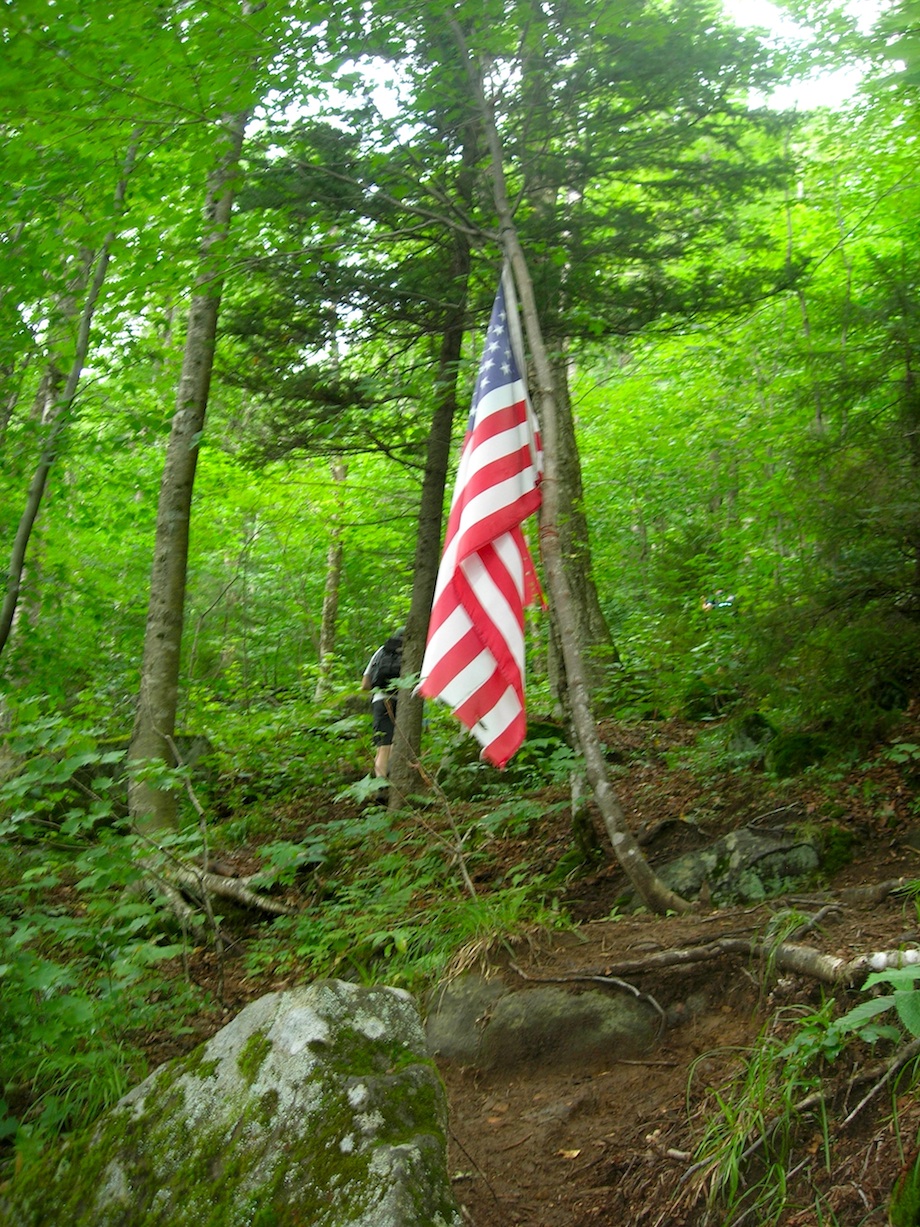
While the rest of our group settled down for lunch, I spent some time alone at the memorial site, thinking about these utterly amazing, utterly ordinary people, and lit a candle in their honor.

flag in the forest mt Waternomee B-18 bomber crash site NH

Everything I know about these people comes from a booklet written by Floyd W. Ramsey, The Night the Bomber Crashed. If you can, read it before you do the hike; it will make a difference, I assure you.

From Meadow to Woods

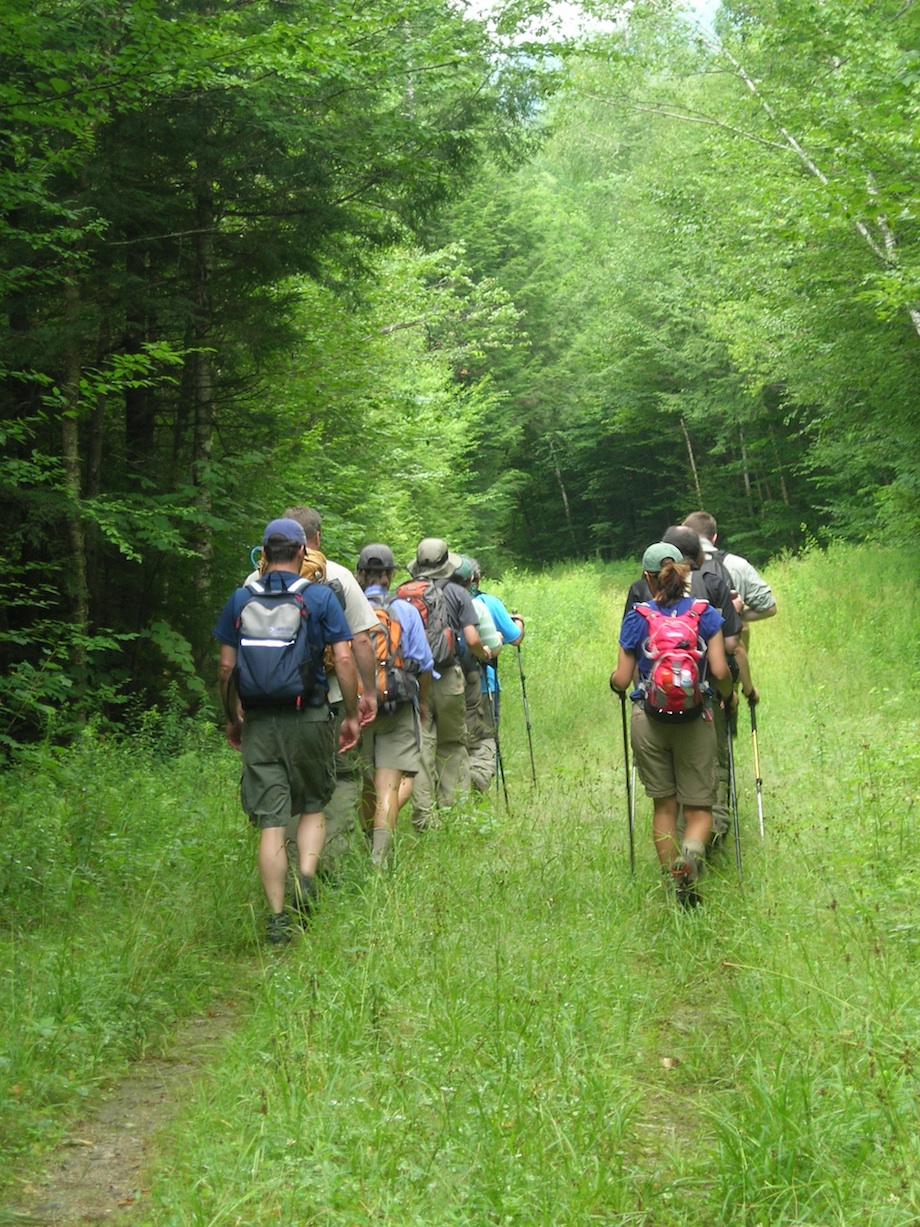
Despite a forecast of rain, we started off our 4.6 miles in sunshine and fine fettle, marching along an old logging road overgrown with grass and wildflowers.

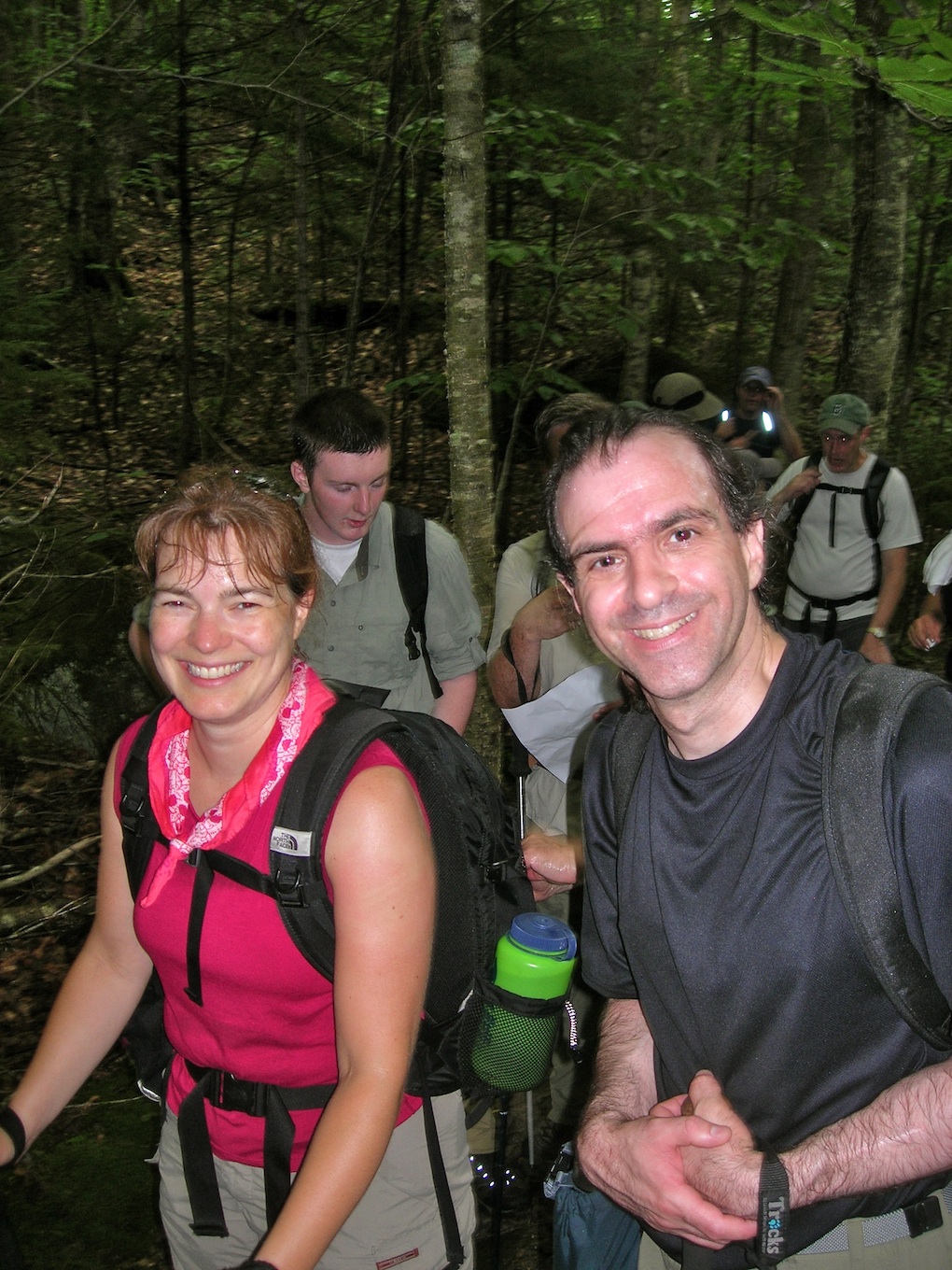
Hiking in two rows B-18 Bomber Hike AMC July 24, 2010

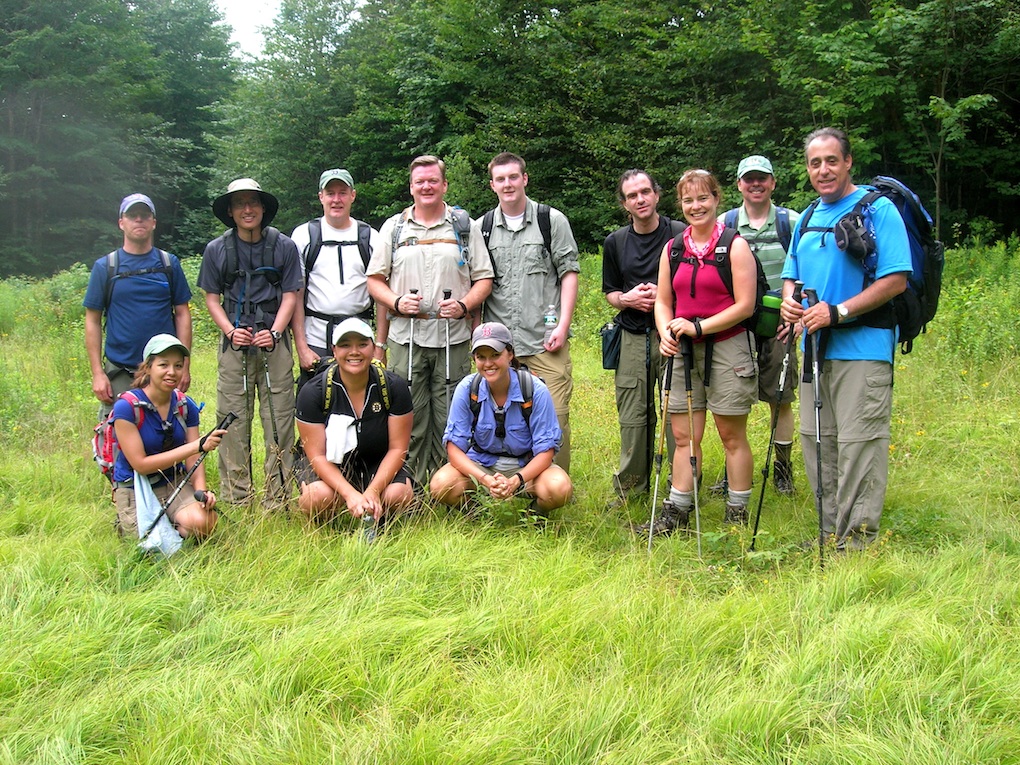
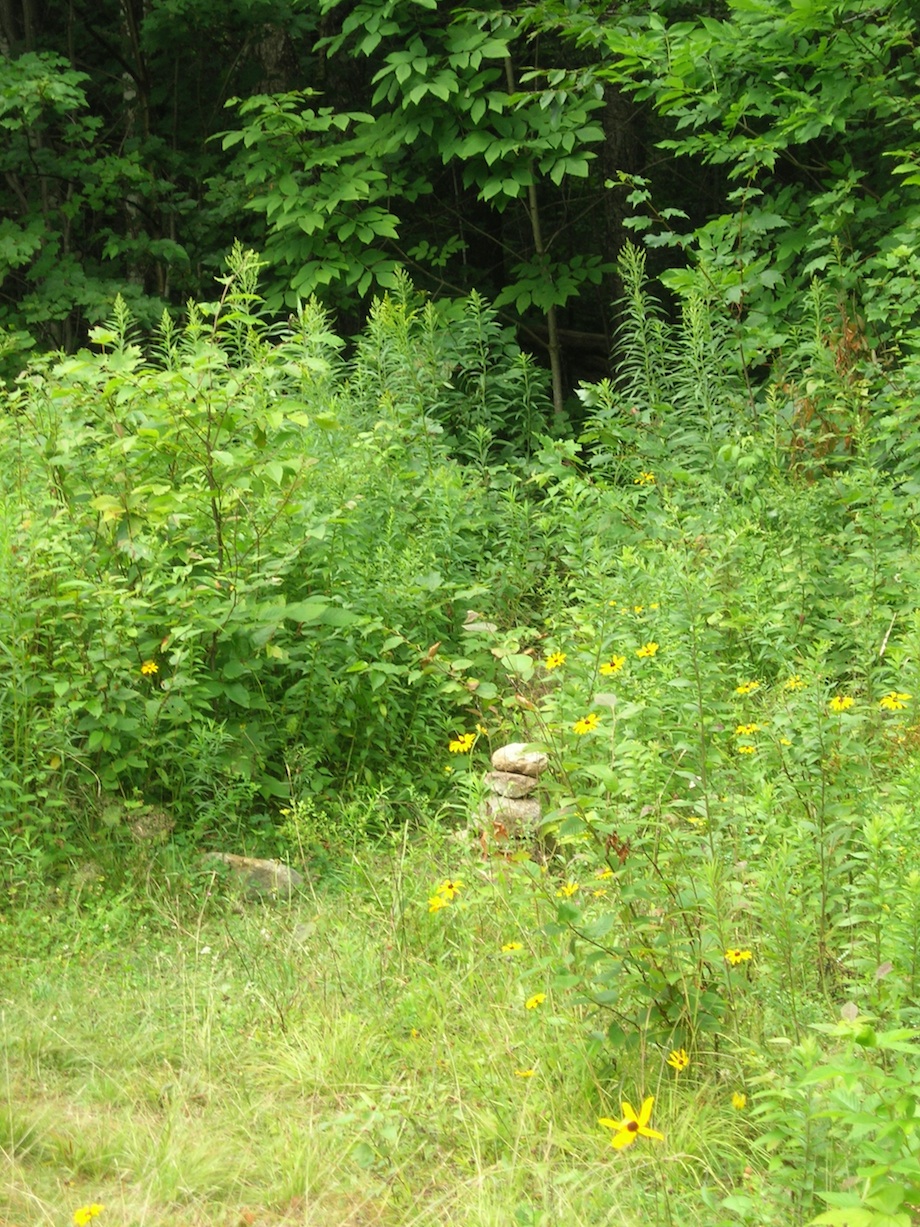
In about half a mile, we came to a surprisingly perfect circle of meadow that signaled our turn onto the trail, and a perfect spot for a group picture. 13 hikers in big meadow circle B-18 Bomber Hike July 24, 2010The trail was marked by a tiny cairn, nearly hidden in the grass, that someone had recently built to mark the way.B-18 bomber Hike AMC July 24, 2010 cairn marking trail into woods

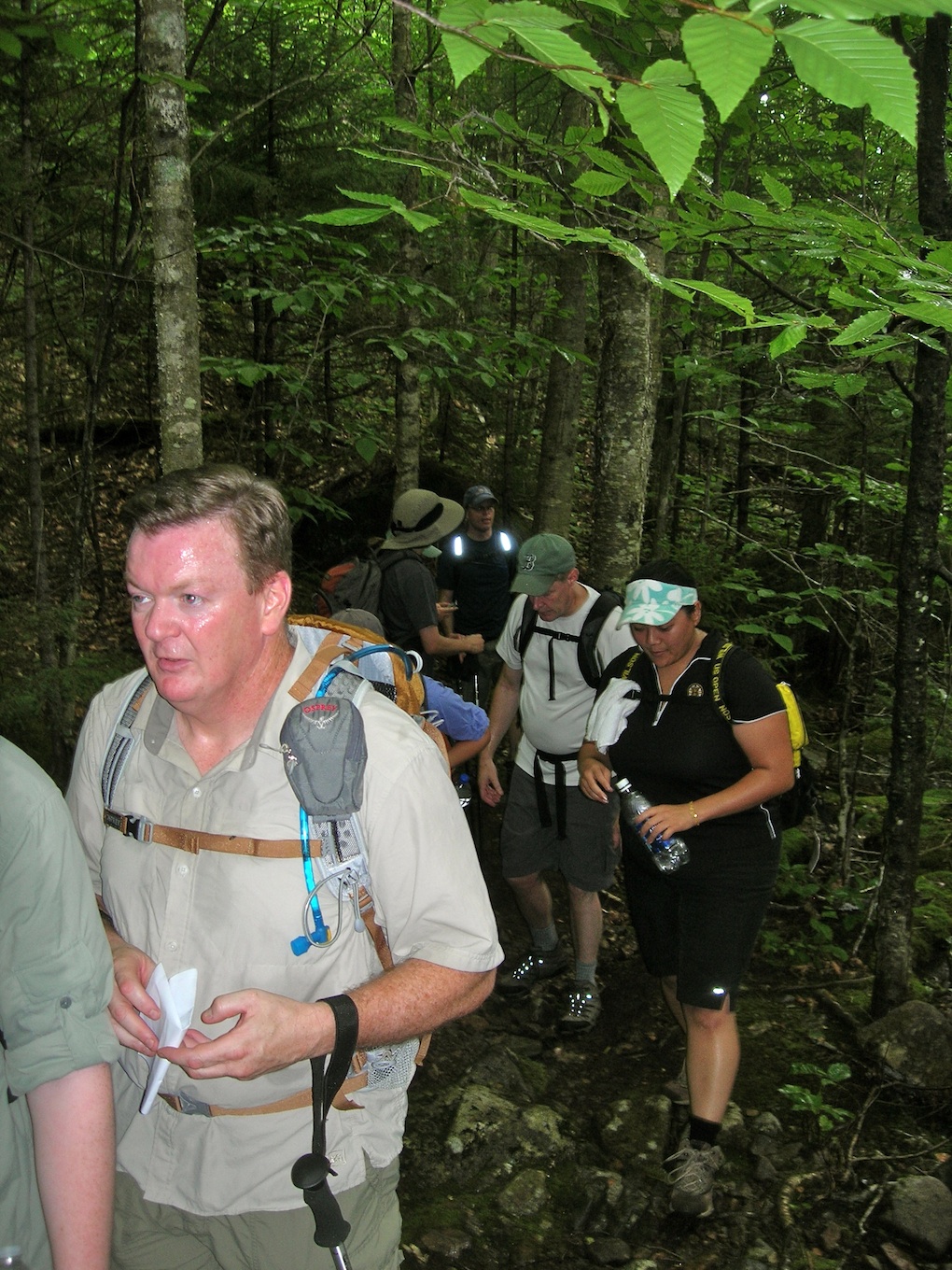
Entering the forest, the landscape changed dramatically. We charged along, sweating in the heat and humidity, grateful for the dense shade. Drinking, a lot of drinking, became de rigueur.

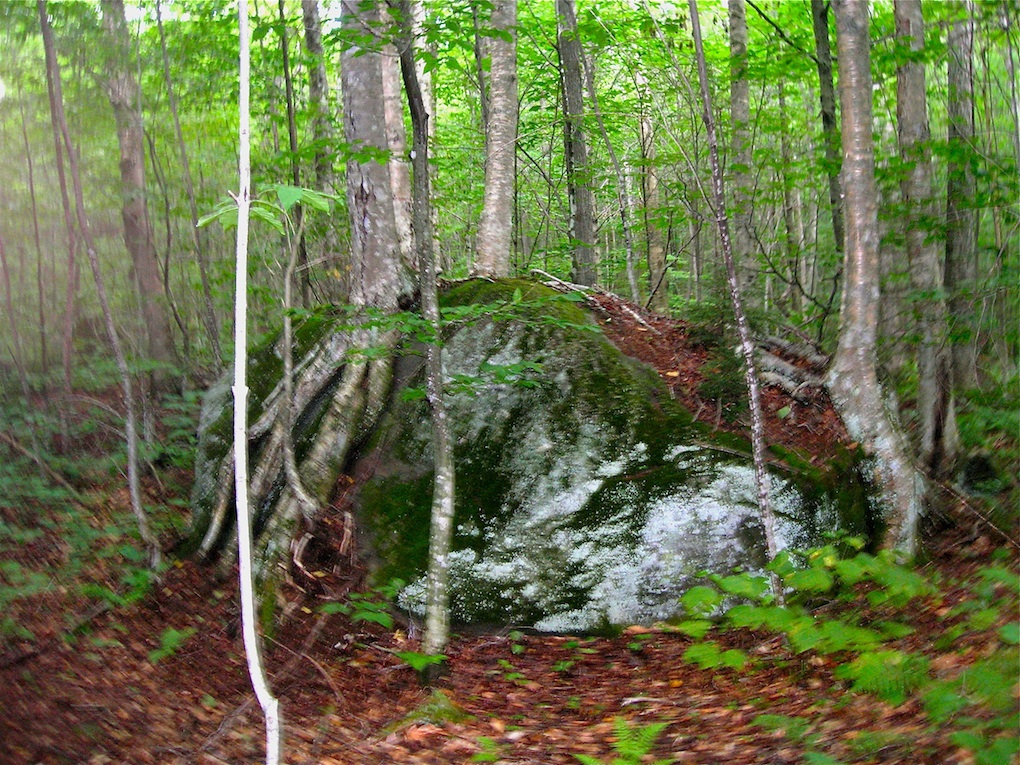
B-18 bomber Hike AMC July 24, 2010 trees growing over rock on trail into woods

The trail steepened considerably, with much of the 1350’ elevation gain coming in the last mile. Sweat soaked our clothes.

At least the footing was nice and soft, almost mushy on this un-maintained and rather unknown trail compared to the usual rocky tramp in the White Mountains. On the other hand, it was slippery. Going up wasn’t so bad, but later on, when we descended, people slipped and slid and the occasional ankle was turned, though none seriously.

The Crash Site

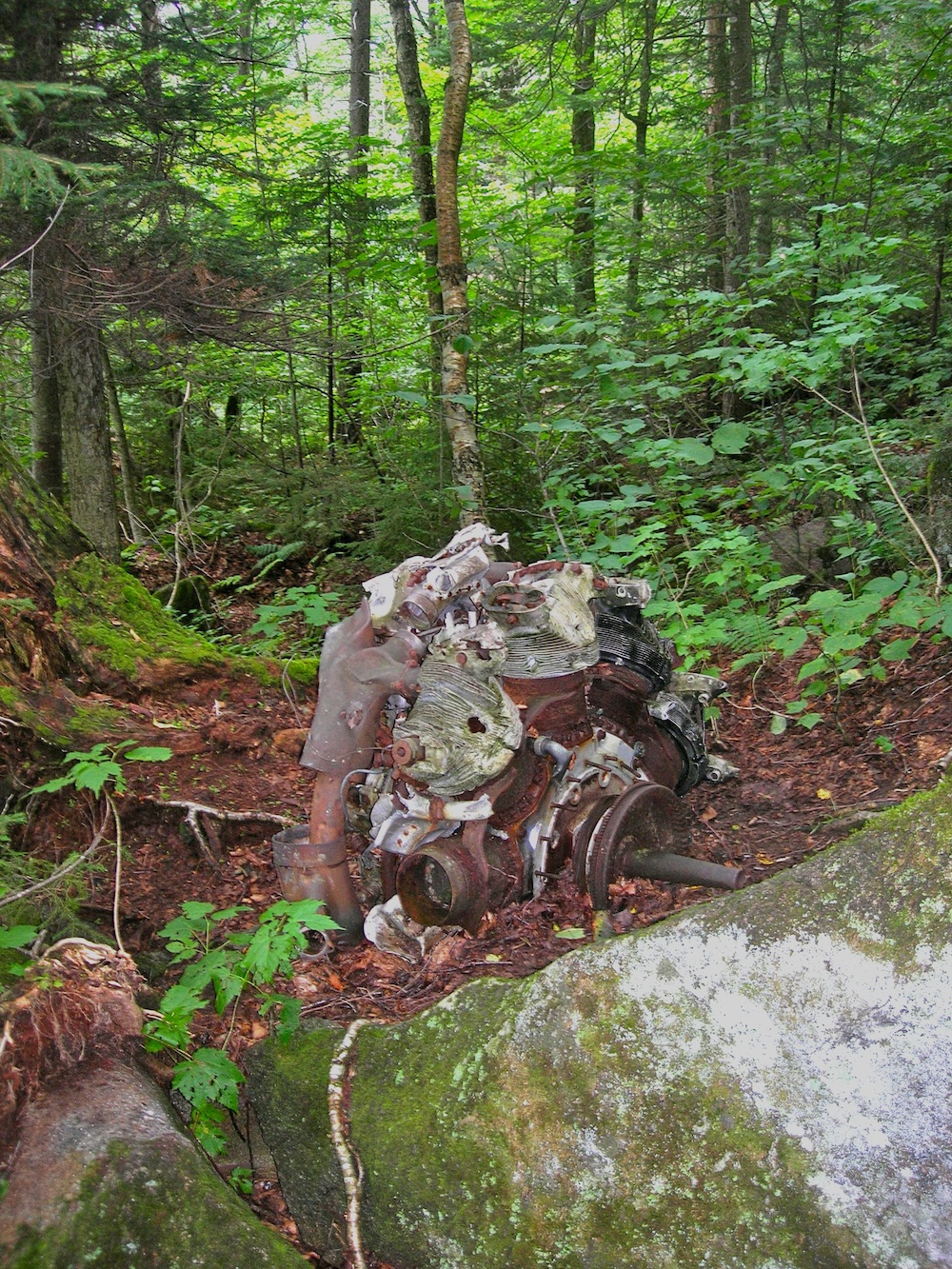
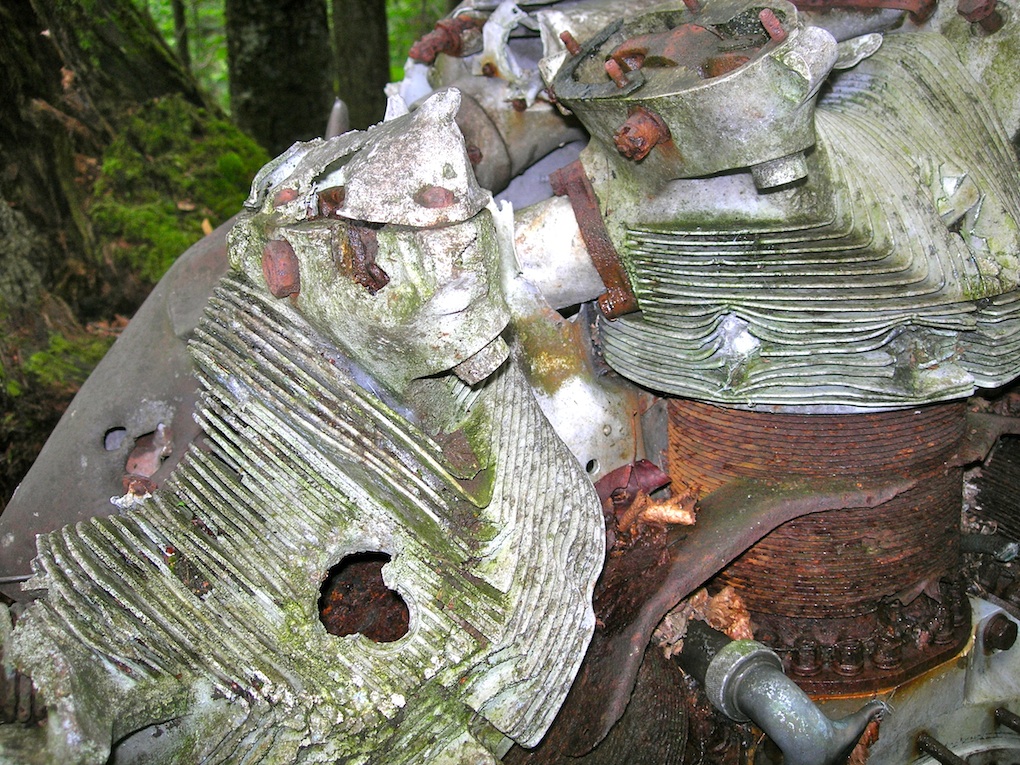
I was merrily chatting away to folks from the “sweep” position, when I noticed that the line of hikers ahead of me had not only stopped but dispersed. What was up? It took me a moment to realize the lump of something to my left was not another rock, but an airplane engine.

B-18 bomber Hike AMC July 24, 2010 engine in woods

The B-18 crashed high and then skidded at an angle through the trees going downhill, tearing off its wings, splitting open the fusilage, and losing its landing gear in the process. But that’s not how you come upon the wreckage. You climb up to the last bits to fall off or explode away.

First you see an engine, then other chunks and hunks or metal and gradually you piece together a doorway, a hydraulic part, and then, at the highest part of the mountain, the wings. Looking down from there you can see the line the bomber made tearing through the forest to its final rest and the explosion of the plane itself and one of the 300 pound bombs it carried.

B-18 bomber Hike AMC July 24, 2010 engine in woods closeup

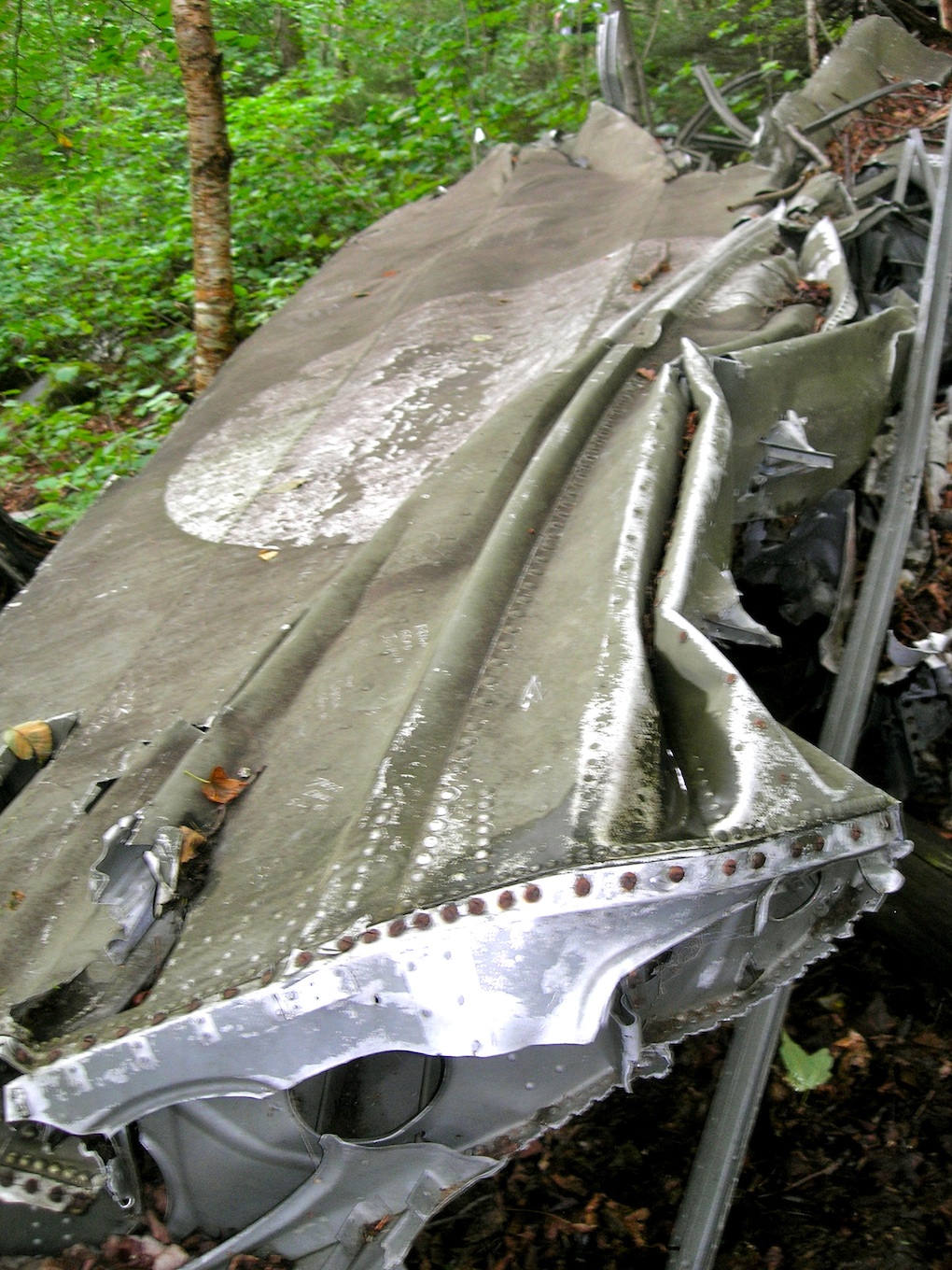
The remaining bomb lay there, near the burning wreckage, the entire time of the rescue. It was eventually detonated by military personnel the next day.B-18 bomber Hike AMC July 24, 2010 wing

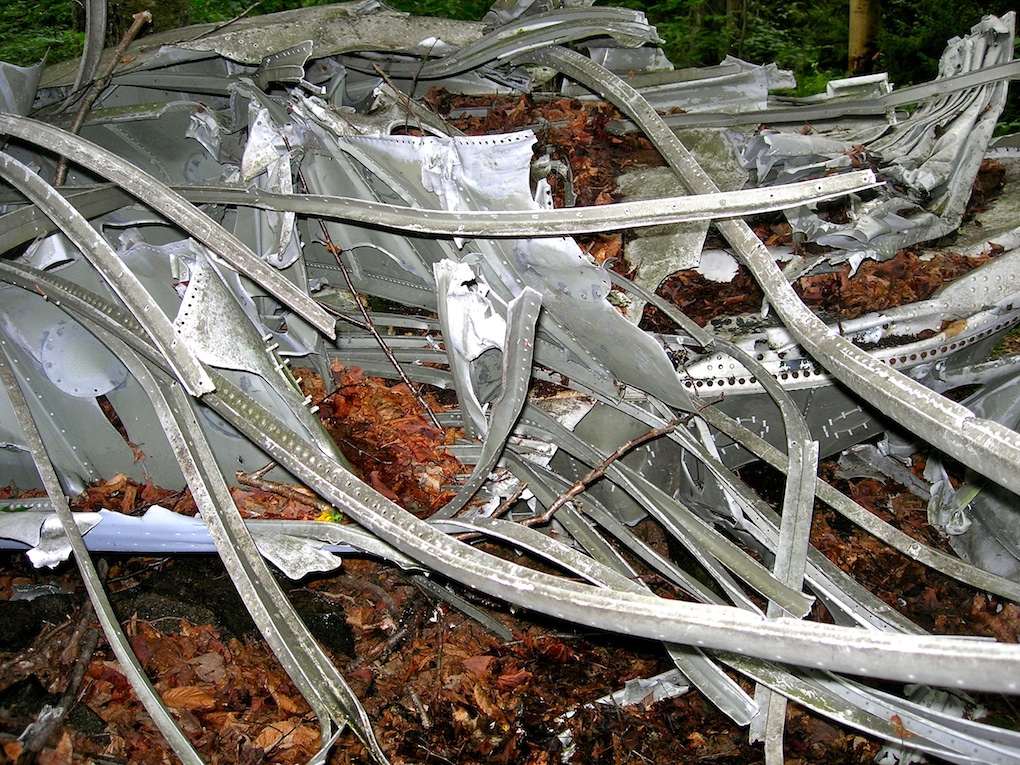
Some of the wreckage takes fantastical shapes. Some of it looks like litter.

Parts of the plane flew far and wide from the various blasts, so the field of discovery is broad here in little traveled Mt. Waternomee.

B-18 bomber Hike AMC July 24, 2010 airplane litter

Though the burn marks and scars on the mountainside have healed completely, it’s astonishing how fresh the metal parts still look despite the nearly seventy years the forest has had to work on them.

fantastical shapes B-18 bomber crash stie July 24, 2010

We Find the Falls

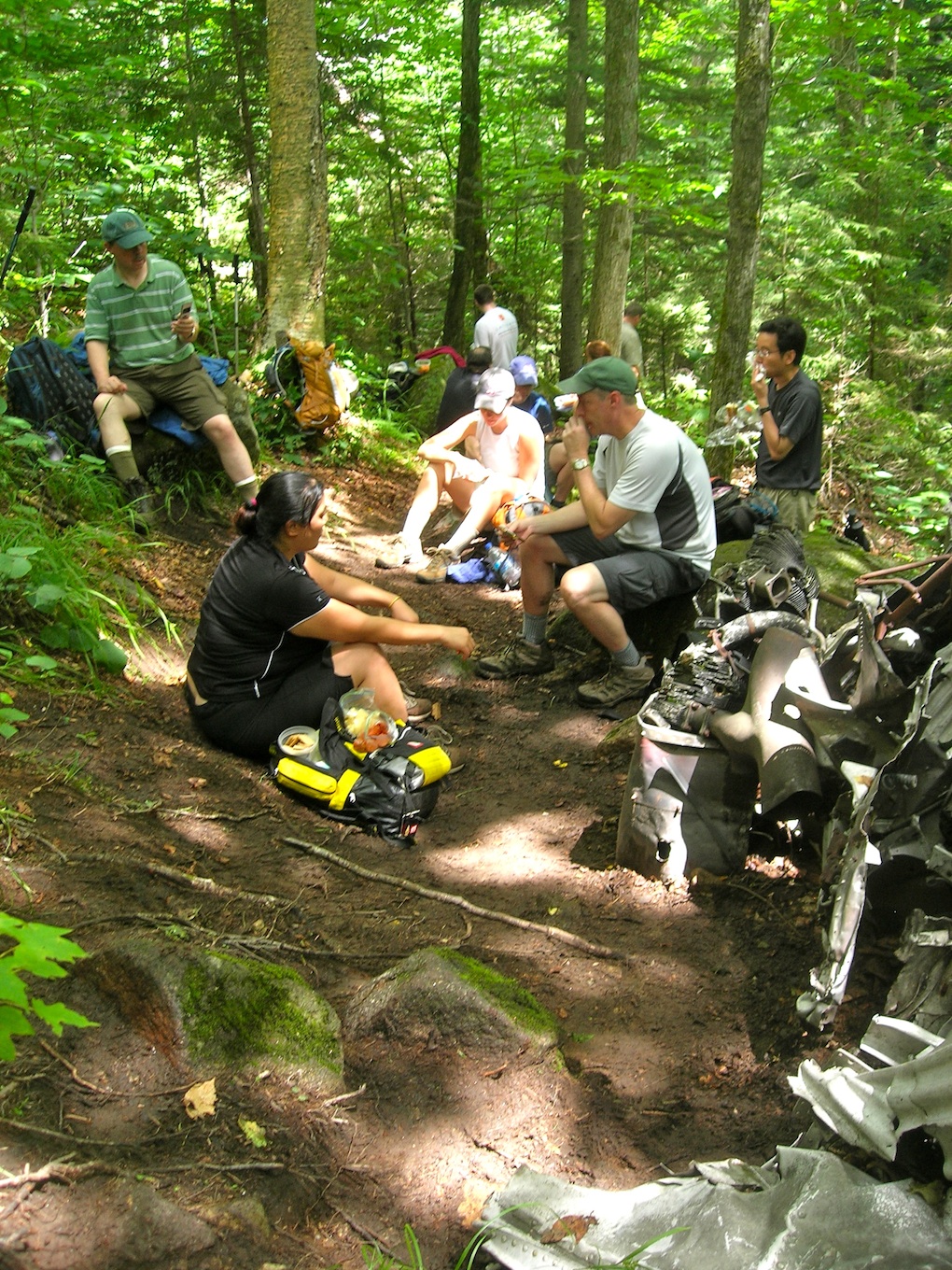
We ate lunch on the flattest spot we could find, surrounded by chunks of wreckage. It felt like sitting in some ancient ruins.

Lunch  B-18 bomber crash stie July 24, 2010

Lunch  second pic  B-18 bomber crash stie July 24, 2010

On our way down Mt. Waternomee, Robert was able to locate the falls he’d seen when he scoped out this hike a few months before. There’s no trail per se, one has to simply wait until the sound of water comes at you from both sides, the climb up the embankment on the left as you face downhill and voila! A beautiful, rugged stretch of rocks and falling water.

Some of us hiked down the steep embankment to the water’s edge while others rested on the trail above. Three adventurers, Andrew, Randy and Frank climbed up the mossy rocks to wet themselves with the cold water and enjoy the refreshing breezes. Not me. I was content to meander along the water’s edge and take pictures.

Randy at waterfalls  B-18 bomber crash stie July 24, 2010

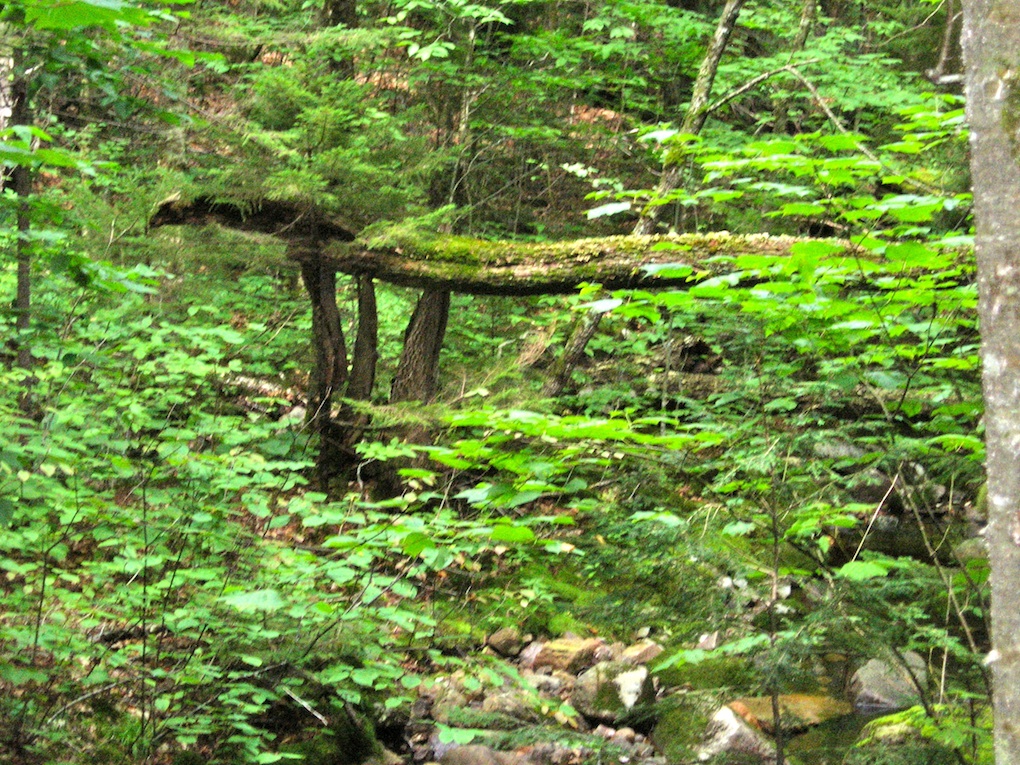
As we came near to the end of our journey through the forest, I noticed an arrangement of Nature that looked like wooden brushstrokes representing a Japanese or Chinese character. What did it symbolize? The word “peace” came to my mind.

What does it say to you?

trees in peace symbol  B-18 bomber crash stie July 24, 2010


by Cheryl Suchors

10 July 2010

Summer Reading

by Cheryl Suchors
Light is the word here. I enjoy light reading. Not as a steady diet, but it’s refreshing in between heavier stuff. So here are some of my hitherto-secret vices. Enjoy, and let us all know what you think of any you read. Also add your own suggestions to the list!
Mysteries
I confess that poorly drawn or insignificant female characters infuriate me. You may guess from this that I like strong female leads and you may also have discovered, as have I, that it’s not so easy to find them. It’s a lot easier than 20 years ago, but still. Here are some authors and characters I’ve taken to.
Denise Mina. I really like this Scottish author who writes about Paddy Meehan, a smart, wise-mouthed reporter from a large Catholic family in Glasgow who struggles with her weight and with making it in a male-dominated field. The style is realistic, gritty and the books are filled with believable characters. I’ve read Garnet Hill, Field of Blood and Slip of the Knife and am forcing myself to slow down so the few remaining I can savor.
Janet Evanovich. There should be a separate category of “ultra-light” for these books in the numbered series that starts with One for the Money. A new one comes out each summer and, yes, my daughter and I have read them all. The first half-dozen or so are laugh-aloud funny, featuring Stephanie Plum, bail bondswoman from Jersey who has a former prostitute for a side kick, a gun-toting granny and a hilarious assortment of characters including cross-dressers, stoners and gangsters who mess up her life.
Batya Gur. Unfortunately, this wonderful Israeli author died too young so there won’t be any more of her thick books that always teach you a lot about something: the world of star cellists, life on a kibbutz, a psychiatric institute in Israel. The protagonist here is male, an intellectual head cop, with sexist other male cops, but even so the writing is so good I’ve read all her six books.
Laurie King. This author writes two series, one set in San Francisco, which I’ve read one or two of and don’t find strong or captivating, but I’m a big fan of the series about Mary Russell, the brilliant young religious scholar who eventually becomes Sherlock Holmes’ partner in all senses of the word. If you can, read them in order; the series starts with The Beekeeper’s Apprentice. I’ve thoroughly enjoyed all but one of these, The Game, which “jumped the shark.” (If you’re not familiar with this term, it’s a film expression that means a film/show has leapt from the bounds of the credible and gone over the top.)
Jacqueline Winspear. Her series about Maisie Dobbs, a working class young woman who receives the gifts of education and apprenticeship that help her set up her own investigative agency to apply psychological insight to the task of solving insolvable cases. It takes place just after World War I in England, a tough time indeed. It’s hard to put my finger on why I like these books. They don’t have much action and the pace is always slow. The atmosphere is very British and there’s something ultimately calming about them and also rewarding because Maisie works hard, never forgets her roots or her obligations, fights her own internal demons and wins. It’s good to read these in order, too. The first is Maisie Dobbs.
Science Fiction
I’ve been reading science fiction on and off for decades. I like all kinds and varieties but particularly futuristic ones where someone has imagined a different world and different ways for women, or female beings not necessarily human, to be in that world.
Having read hundreds of authors in the field, allow me to share with you my favorite science fiction author of all time: C. J. Cherryh. She’s written over 60 novels (yes, 60!) and won three Hugo awards. By all rights, she should have won at least a dozen more Hugos and numerous other awards, but she began writing in the 1970s when publishers (mostly male) believed sci-fi readers (mostly male) wouldn’t read a woman author (hence her use of initials) and didn’t give enough credit to her genius. Even now she doesn’t get her just due.
The woman is brilliant. She’s written in every genre of science fiction there is and creates entire universes with different series in different sectors of them. I mean, really. No other author has been so bold, so imaginative with so large a vision.
If you like advanced technological worlds, read her Cyteen series that deals with cloning and regeneration and all the complications of economics and government and morals. If you like space-faring wild cat-type people where all the ship captains and crew are female and the men stay home with the children, read the Chanur novels.
Should you prefer long ago worlds where people rode horses and there were brave, lonely mercenaries try The Morgaine Cycle books where such a mercenary (male) follows the mysterious and tormented Morgaine through gates to different worlds on a quest to save everyone.
For different species, check out The Faded Sun novels for a desert planet and people who have become homeless. They must figure out how to deal with a human male who shows up in their midst and he must learn their ways.
Carolyn Cherryh can write anything, and indeed has done fantasy as well, with the saga of Jones, a smart, tough river-boating woman who saves an upper class guy from drowning and creates an uneasy alliance with him, filled with intrigue. This series is called Merovingen Nights. I want to adopt Jones. Or have her adopt me.
Anyway, this list doesn’t cover all the worlds and species and economies and governing structures C.J. Cherryh has created, but there are more on her website.
Amazing Special Offer – Free!
When you leave a post here, I’ll email you back with my very favorite science fiction novel, one of the few books of any kind I’ve ever read more than twice, because this book has it all. If you’re only going to read one piece of science fiction in your life, this is the one!
PS:  Support your independent bookstore.
—Cheryl Suchors